
Today, printing customised envelopes remains widely used in the business environment for many purposes, such as direct marketing mailings, invitations and greeting cards. In addition, electoral envelopes are essential in the institutional context when elections are approaching.
In all cases, selecting the right envelope type and paper is essential to ensure a professional appearance and reliable functionality.
Types of customised envelopes for businesses and institutions
There is a wide variety of envelopes available, each designed for specific uses. The most common types include:
- Letter envelopes These are the most widely used envelopes for business correspondence. They usually follow the standard size of 4.125 × 9.5 inches (DL format) and are ideal for sending documents, letters and invoices.
- Window envelopes These envelopes include a transparent window on the front that displays the recipient’s address printed on the document inside. They are commonly used for sending invoices and official documents.
- Padded envelopes These envelopes include a protective inner layer designed to safeguard sensitive materials or fragile items during transport.
- Flat envelopes Larger envelopes designed to send flat materials such as brochures, catalogues or large documents.
When printing envelopes for elections, it is advisable to consider the following aspects:
✅Verify local and national regulations
It is important to ensure compliance with local and national regulations regarding the printing of electoral materials, particularly when envelopes are used in municipal or general elections. This includes format, size, colour and envelope design requirements.
✅ Use a professional design
Envelope printing represents the image of a company or a political organisation. Therefore, it is important to use a professional design that reflects the brand identity or political message. This includes printed envelopes with logos, corporate colours or appropriate political symbols.
✅ Select the appropriate paper type
To ensure a professional and durable result, choosing the right paper type is essential. The paper should match the intended use of the envelopes, the required print quality and the applicable regulations.
✅Check print quality
Before printing large quantities of envelopes, it is recommended to carry out print tests to ensure that the quality meets expectations. This includes checking text clarity, colour accuracy and the correct alignment of design elements.
✅Consider the quantity to be printed
The number of envelopes to be printed is another important factor. Depending on the required quantity, different printing methods may be more appropriate, such as digital printing or offset printing.
With these recommendations in mind, it is possible to achieve successful results when printing customised envelopes for business, political or institutional purposes.
Envelopes for general and municipal elections
In the context of municipal and general elections, printed envelopes become particularly important because they are used to send electoral materials, such as ballot papers and official voting documents, to voters.
Format, colour and type of electoral envelopes
- The format most commonly used in municipal and general elections is the C6 or C5 envelope, widely used in many countries for voting materials. These sizes provide sufficient space to safely and confidentially contain ballot papers and other relevant documents.
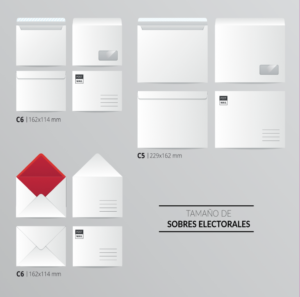
- Regarding colour, electoral envelopes are usually printed in neutral colours, such as white or cream, in order to maintain neutrality and transparency during the electoral process. In some cases, specific regulations determine the colours used for electoral envelopes to distinguish between ballot papers for different elections (municipal, general, etc.) or between different political parties.
- The most common type of envelope used in elections is the standard envelope without a window, which ensures that ballot papers and voting documents remain confidential. The exact type of envelope may vary depending on local regulations and the specific requirements of the electoral process.
- In terms of paper, electoral envelopes are typically produced using high-quality paper that meets the required confidentiality standards, such as opaque paper or coated paper (couché). Choosing resistant paper is essential to prevent the contents from being visible through the envelope, ensuring voter privacy and protecting the integrity of the electoral process. Increasingly, envelopes made from recycled paper are also used due to environmental considerations.
In summary, printing envelopes for elections should be carried out by reliable printers specialised in electoral print production to guarantee confidentiality, compliance with regulations and the integrity of the materials.Today, printing customised envelopes remains widely used in the business environment for many purposes, such as direct marketing mailings, invitations and greeting cards. In addition, electoral envelopes are essential in the institutional context when elections are approaching.