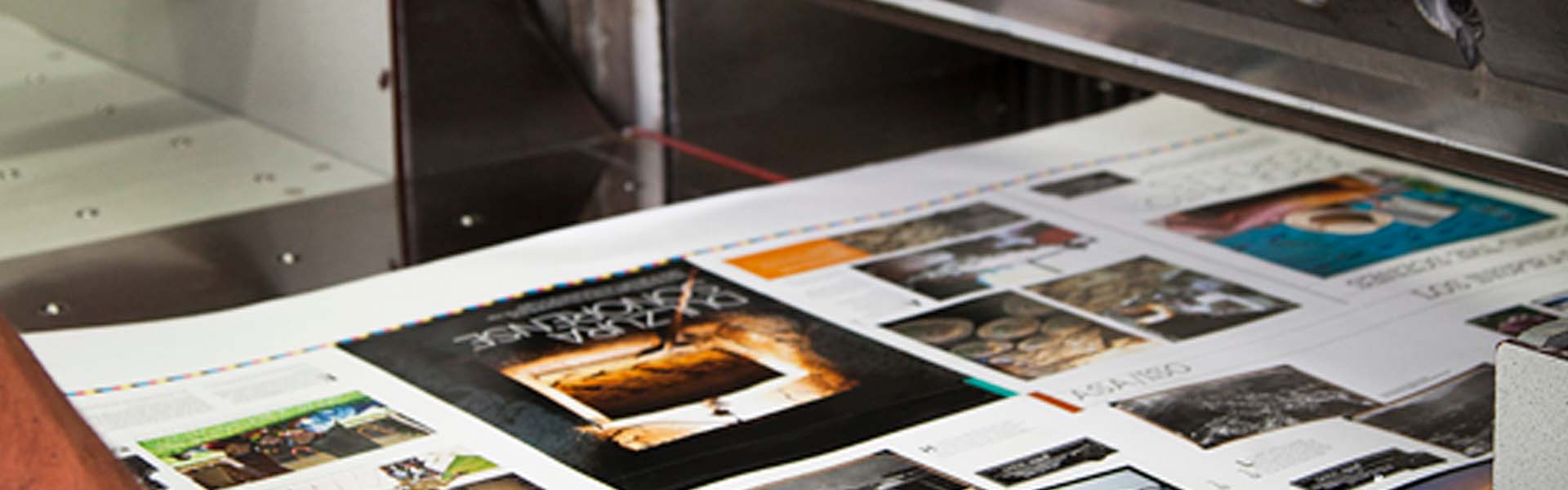
Digital printing consists of printing directly from a digital file onto virtually any material. Do you know what marked the beginning of digital printing? The launch of digital printing in 1993, better known as Indigo. Its main contribution was that, for the first time, high-quality prints could be produced in short runs and at high speed.
What types of digital printing are there?
A simplified classification of direct printing from digital files mainly distinguishes three types:
- Inkjet: This printing method uses a digital image that is reproduced by projecting hundreds of tiny ink droplets onto the substrate.
- Laser: In this case, the image is transferred from the digital file to the substrate using a laser. During the process, the laser moves across a drum inside the printer, creating static electricity that attracts toner to form the desired image.
- Solid ink: A printing system used by many office printers and multifunction devices. It uses solid ink cartridges that are melted during printing. This system is also used in large-scale applications. In general, printing is carried out using a wax-based resin polymer.
There are also different types of digital printing technologies such as digital press printing (high-volume production with immediate execution and high quality), thermal sublimation (heat transfer to apply the image onto a predefined substrate) and UV printing (printing with inks that dry almost instantly through ultraviolet light).
What can be printed with digital printing?
One of its main characteristics is that it does not require printing plates, as printers create the image directly on the selected substrate.
Thanks to this, and continuous technological advances, the possibilities are almost unlimited. It is possible to print small-format materials as well as large-format graphics with excellent quality. In fact, large outdoor advertising formats in major cities are produced using digital printing.
Its versatility is therefore its main strength, and it can be applied to:
- Paper: The most common substrate. Used for books, catalogues, brochures, stickers, leaflets and posters.
- Cardboard: Widely used for greeting cards, postcards and business cards.
- Folding cartons: The development of digital printing has significantly improved packaging in terms of quality and visual impact. Packaging and storage boxes have also benefited from this evolution.
- PVC banner (large-format flexible banner): A highly resistant material suitable for displays, stands and large outdoor advertising formats.
- Textile: Various types of fabrics are used for displays, banners and hanging structures for multiple applications.
- Metal substrates: Some POS materials (POSM) and interior decoration projects use digital printing on metal surfaces, delivering a striking visual effect.
- Wood: An innovative application in visual communication and interior design.
Advantages of digital printing
The growth and adoption of this system are mainly due to the following benefits:
- Cost efficiency: Setup costs are lower than in traditional printing.
- Short runs: It allows production of very small quantities, even a single unit.
- Flexibility and versatility: Supports a wide range of applications and printable materials.
- Personalisation: Enables variable data printing, such as numbering or customised content.
- Speed: As printing is done directly from file to substrate, production times are significantly reduced.
Let Artyplan’s experts support your project
At Artyplan, we offer a wide range of print production services and products. Our team is ready to support your digital printing projects. Discover how our Print Management service adapts to your needs and helps you find the most efficient solution.