In a world where technology is advancing rapidly, augmented reality (AR) is emerging as a revolutionary tool that is redefining the printing industry.
This innovation not only expands the boundaries of what is possible in terms of design and presentation, but also opens up new opportunities for businesses to improve communication, marketing and operations. This article explores how augmented reality is transforming the print sector and why it represents the future of the industry.
What is Augmented Reality?
Augmented reality combines digital elements with the physical world in real time, creating an interactive experience that can be viewed through devices such as smartphones, tablets or specialised glasses.
Unlike virtual reality, which creates a completely artificial environment, AR enhances the real environment with digital overlays, enriching the user’s perception and adding a new dimension to the visual experience.
Innovative Applications in the Industry
Innovative applications in the industry are transforming sectors such as advertising, education, product packaging and the organisation of trade shows and events. Augmented reality (AR) stands out as a powerful tool that delivers personalised and enriched experiences, transforming the way users interact with brands, educational content, products and events.
- Advertising and Marketing:
Advertising campaigns that incorporate AR can deliver personalised and highly interactive experiences, improving the effectiveness of marketing messages and strengthening the emotional connection with the brand. - Education and Training:
Educational materials enriched with AR can transform the way students learn by offering interactive simulations and access to additional content that enhances understanding and engagement. AR-based learning materials can make complex concepts more accessible and attractive, improving learning experiences and knowledge retention. - Product Packaging:
Packaging enhanced with AR can provide consumers with additional product information, interactive usage instructions and direct access to promotions or exclusive content, adding significant value to the product. - Trade Shows and Events:
Printed materials with AR can enrich the experience of attendees at trade shows and events by offering virtual tours, detailed information about products and services, and personalised interactive experiences.
Benefits of Integrating Augmented Reality in Print Services
Integrating augmented reality into print services offers multiple advantages for both printing companies and their clients.
- Product differentiation:
AR offers a way to stand out in a saturated market by delivering unique experiences that can strengthen brand value and customer loyalty. - Improved customer interaction:
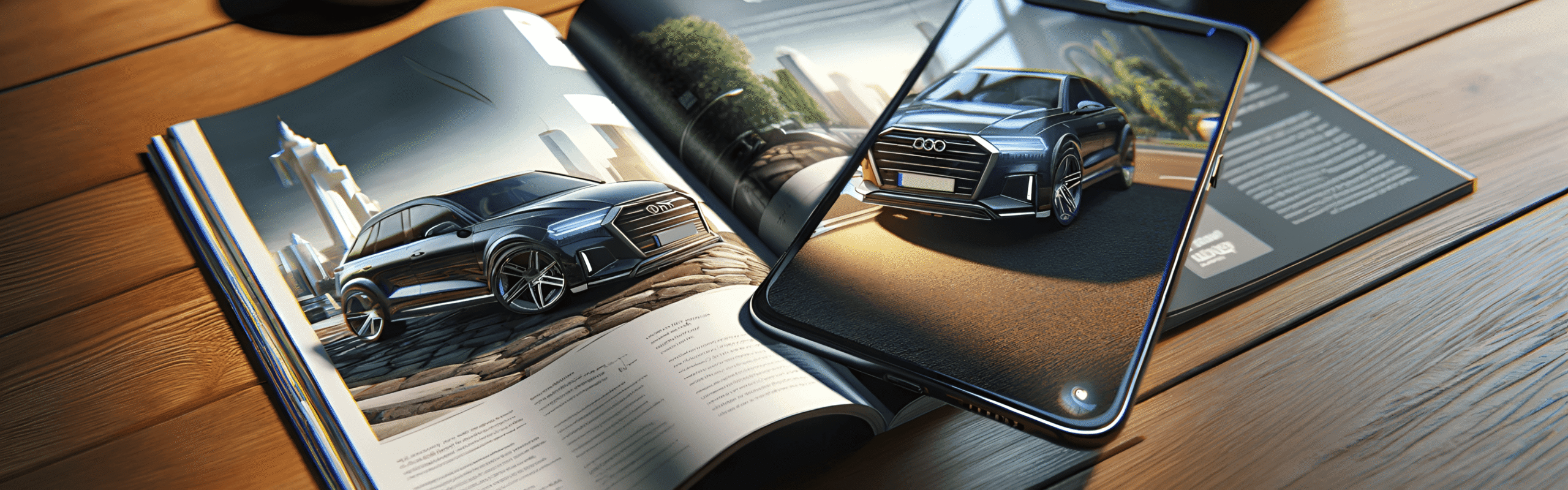
AR transforms static printed materials such as brochures, magazines, posters and packaging into interactive digital experiences with videos, animations, music and web links. By offering interactive content, businesses can connect with audiences more effectively and create deeper engagement. - Memorability:
Immersive and entertaining experiences are more likely to be remembered by consumers, increasing the effectiveness of advertising campaigns. - Personalisation and unique experiences:
Brands can offer content tailored to the user’s location, scanning moment or profile, providing a powerful level of personalisation that is difficult to achieve with traditional printed media. - Data and insights:
AR can provide valuable data about how users interact with printed materials, offering insights into consumer behaviour and preferences to optimise marketing strategies and product design. - Sustainability:
AR can contribute to sustainability by reducing the need for additional printed materials through partial digitalisation of content, helping to reduce environmental impact.
Although augmented reality offers many advantages, its implementation in advertising and print projects also presents challenges. These include investment in advanced technology and the creation of high-quality digital content that fully leverages AR capabilities. It is also important to ensure that AR experiences remain accessible and easy to use for all audiences, regardless of their familiarity with the technology.
The Future of Print with Augmented Reality
The adoption of augmented reality in the print industry is still in its early stages, but its potential to transform the sector is significant. As AR technology becomes more accessible and its integration with mobile devices continues to expand, wider adoption is expected.The ability of AR to combine the physical and digital worlds opens new possibilities for creativity, customer engagement and operational efficiency, positioning augmented reality as a fundamental pillar in the future of print.
Augmented reality is redefining the potential of printed materials, transforming them into interactive tools and offering richer user experiences. Companies that adopt this technology will not only stay at the forefront of innovation but will also deliver more engaging and memorable experiences for their customers, strengthening their position in the market.