
A promotional campaign that looks brilliant on paper can become an operational problem the day it has to arrive simultaneously and in perfect condition at 137 stores across Spain. The challenge for modern trade marketing is not designing the display; it is orchestrating production, inventory, and distribution so that every point of sale receives exactly what it needs, when it needs it. This guide explains how to achieve that without multiplying suppliers or losing traceability.
How to Manage POS Campaigns Across More Than 100 Stores
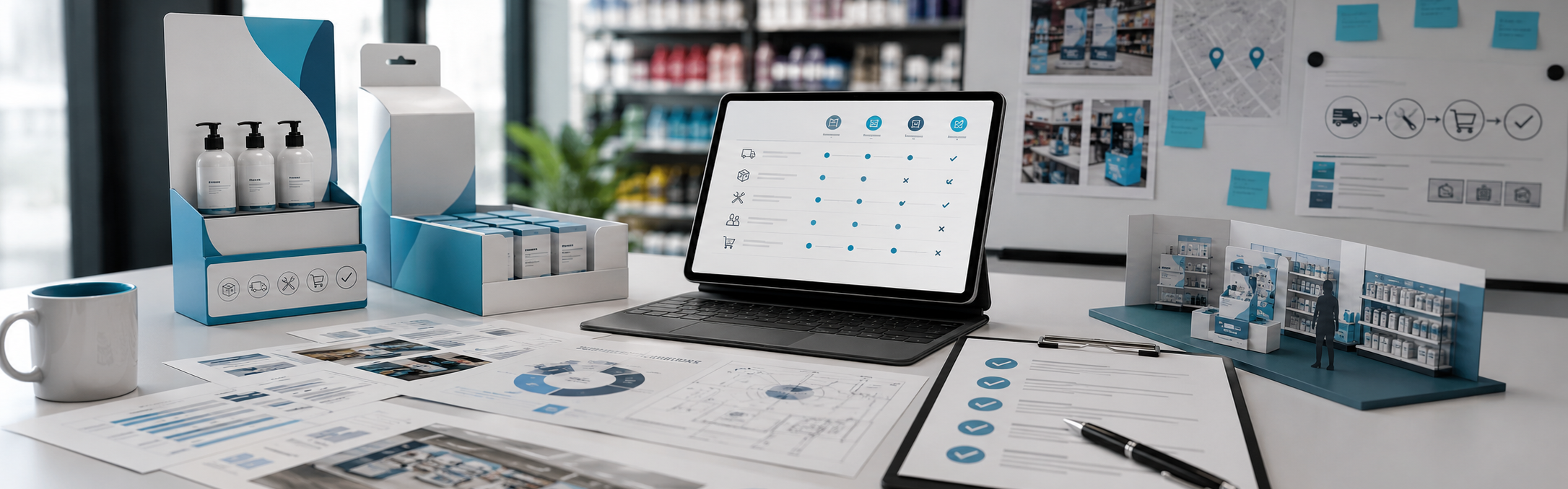
Managing POS campaigns across more than 100 stores requires four integrated capabilities: (1) industrial production with consistent quality, (2) centralized warehousing and inventory management, (3) picking, kitting, and nationwide distribution with full traceability, and (4) a digital platform that provides real-time visibility. The most expensive mistake is fragmenting these four functions across different suppliers.
The Real Problem: Fragmentation, Not Production
When a retail or FMCG brand launches a campaign across its store network, the bottleneck is rarely printing. Industrial print providers can produce thousands of pieces without difficulty. The problem comes afterward: who stores the materials until the activation date? Who prepares customized kits for different store formats? Who ensures that the stores in Vigo and Girona receive their shipments on the same day? And above all, who takes responsibility when something goes wrong? The traditional model distributes these functions among three or four providers—a printer, a logistics operator, an installer, and sometimes an inventory manager—leaving the trade marketing manager responsible for coordinating them all. Every handoff between suppliers becomes a potential point of failure and a loss of traceability.
of purchasing decisions are made in-store, making POS advertising a direct sales driver.
was generated by Retail Media in Spain in 2024, representing year-over-year growth of 17.6%.
corresponds to the in-store channel (POS and digital screens), which is undergoing significant digital transformation.
Sources: The New Retail (2024); retail shopper behavior studies.
The 4 Capabilities You Need to Integrate
1. Production with Consistent Quality
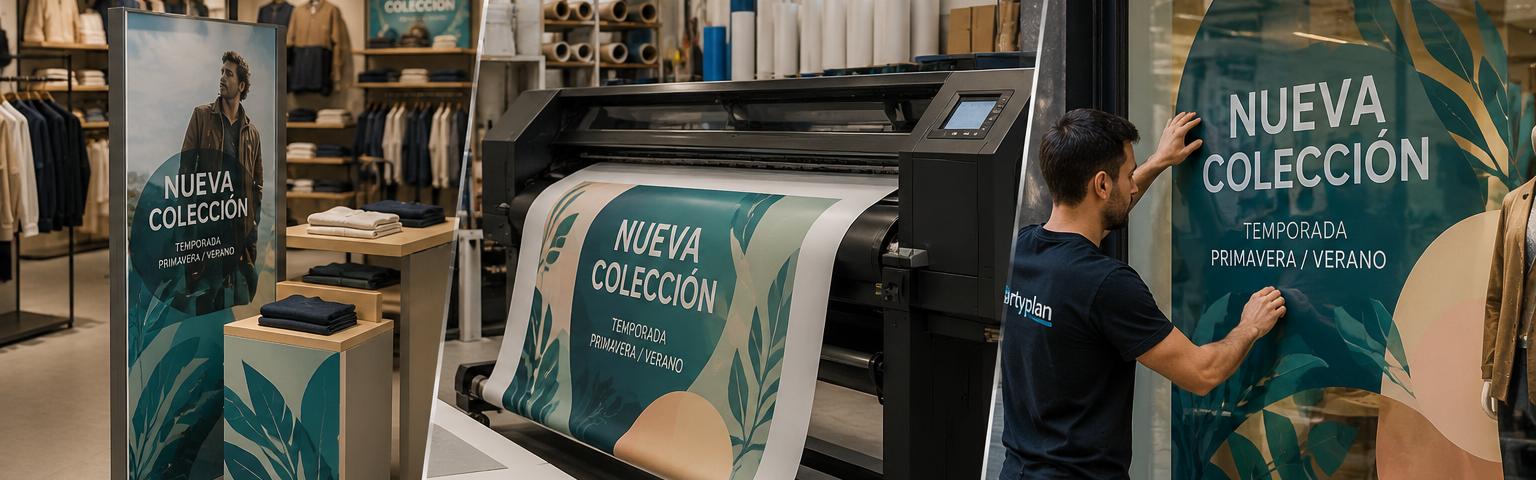
In a multi-store campaign, consistency matters more than isolated perfection. A display with the correct corporate blue in Store A but a color shift in Store B damages the brand coherence the campaign is meant to reinforce. This requires calibrated color management and industrial-scale production with repeatability across print runs—not artisanal, batch-by-batch printing.
2. Centralized Warehousing and Inventory Management
Campaigns are not activated the day they are printed. Weeks may pass between production and activation, and the materials require storage. A supplier with its own warehouse can produce in advance—taking advantage of available production capacity—and release inventory just in time. This is especially important for recurring campaigns: brands that repeat activations every season benefit from keeping reusable structures and materials in managed inventory.
3. Picking, Kitting, and Nationwide Distribution
This is where most projects break down. Not all stores are the same: a flagship store requires a complete kit, while a neighborhood store may need a reduced version. Picking and kitting—preparing customized orders by point-of-sale type—is a specialized logistics capability. Combined with a nationwide distribution network and multi-site delivery management, it ensures that every store receives the correct kit on the agreed date.
4. Real-Time Visibility
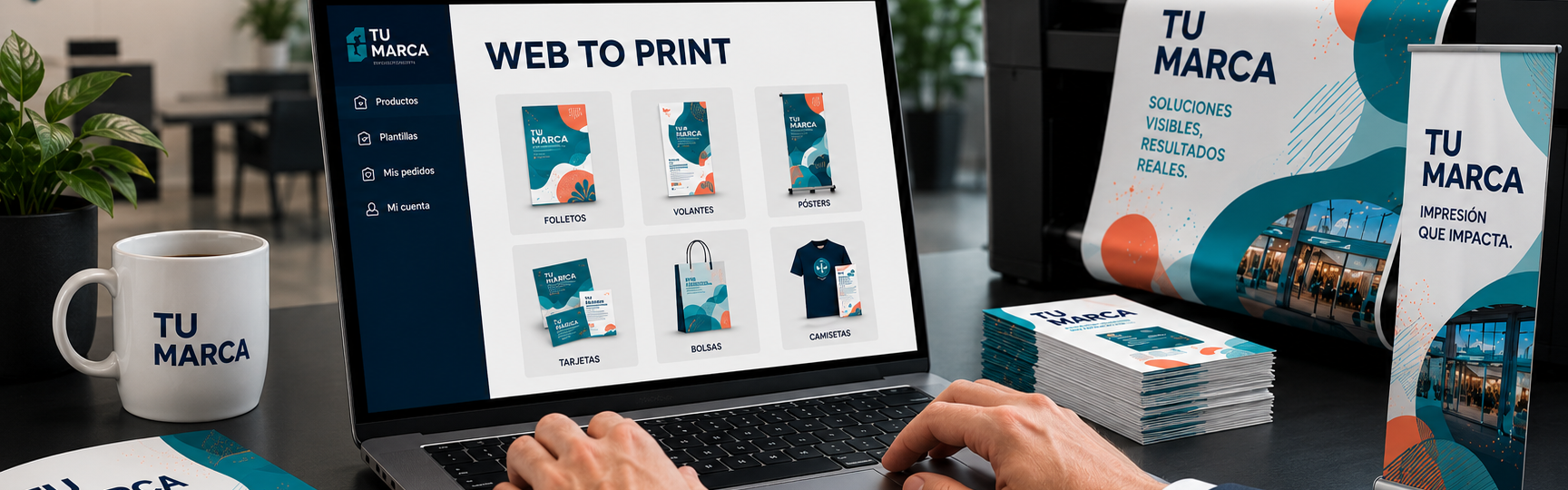
Trade marketing managers need to know, at any moment, what has been produced, what is in stock, what has been shipped, and what has been delivered. Without a digital control panel, that visibility depends on email chains and phone calls. A management platform—ideally integrated with the client’s ERP—turns uncertainty into actionable data.
| Dimension | Multiple Suppliers | Integrated Provider |
|---|---|---|
| Point of Contact | 3–5 different contacts | Single point of contact |
| Traceability | Lost across interfaces | End-to-end, batch-level tracking |
| Accountability for Failures | Diluted ("it wasn't our responsibility") | Single contractual responsibility (SLA) |
| Coordination Costs | High (hidden in internal hours) | Absorbed by the provider |
| Demand Peaks | Each supplier scales differently | Coordinated 24/7 capacity |
| Implementation Time | Sum of sequential lead times | Optimized parallel processes |
How to Measure Whether Your Supplier Is Delivering: The KPIs That Matter
A professionally managed multi-store campaign should be measured using objective indicators, not good intentions. These are the three metrics every recurring print production contract should include as SLAs:
- OTIF (On Time In Full): Percentage of deliveries completed on time and in full. A mature supplier tracks and commits to this KPI; a benchmark level is around 97%, reviewed quarterly.
- Lead time: the period from order confirmation to delivery. For standard production, 5–7 business days is a competitive benchmark; urgent requests should be fulfilled within 24 hours.
- Incident rate: the proportion of orders with errors or complaints. The goal is not absolute zero, but a downward trend supported by documented root-cause analysis.
With six decades of experience serving FMCG and retail brands—including Kellogg’s, Nestlé, ALDI, and Bonpreu—Artyplan has integrated all four capabilities into a single operating model: industrial production in its Barcelona (+5,000 m²) and Madrid (+2,000 m²) hubs, in-house warehousing and picking, nationwide distribution with daily transfers between facilities, and a Web2Print platform with online inventory control that integrates with client systems. The result is a single point of contact accountable for the entire supply chain, backed by measurable SLAs.
Checklist: 7 Questions Before Awarding a Multi-Store Campaign
- Does the supplier produce, store, and distribute in-house, or do they subcontract part of the chain?
- Do they offer batch-level traceability and real-time visibility into the status of every order?
- Can they absorb demand peaks (Christmas campaigns, Black Friday) without compromising lead times?
- Can they prepare differentiated kits by store type (picking and kitting)?
- Do they commit to contractual KPIs (OTIF, lead time) with regular performance reviews?
- Does their management platform integrate with your ERP or internal systems?
- Do they hold certifications that support quality and sustainability (ISO 9001, ISO 14001, FSC)?
The Hidden Cost of Fragmentation: What Doesn't Appear on the Invoice
When a trade marketing team compares supplier quotes, it often focuses on the unit production cost. This is the most common—and most expensive—calculation mistake. The real cost of a multi-store campaign includes items that never appear on an invoice because they are absorbed by the internal team: the hours spent coordinating suppliers, chasing deliveries, resolving in-store incidents, reworking incorrectly executed orders, and explaining delays to commercial management. A Total Cost of Ownership (TCO) analysis in marketing operations often reveals that these coordination hours represent between 15% and 25% of the project’s value. In other words, a campaign that appears to cost €80,000 may actually exceed €95,000 once team time is factored in.
Consolidating production with an integrated supplier does not eliminate that cost—it transfers it to the supplier, who manages it through specialized processes rather than improvised hours from the brand manager.
“In multi-store print production, the cost per piece is only the visible part of the iceberg. Coordination costs, reprints caused by errors, and in-store incidents are the hidden portion—and they usually weigh more.”
Demand Peaks: The Test That Separates Suppliers
Any supplier can manage a small campaign during a quiet month. The real test comes during peak periods: a Christmas campaign that coincides with Black Friday, a nationwide launch that must be executed within two weeks, or a last-minute promotion approved on Friday for rollout on Monday. At those moments, a supplier without its own production and warehousing capacity either collapses or outsources work—losing quality control and traceability precisely when they matter most. The ability to absorb demand peaks depends on three structural factors: Scalable production shifts (ideally facilities operating 24/7), safety stock of materials managed in advance, an in-house logistics network that does not depend on third-party availability during peak seasons. Brands evaluating suppliers for recurring contracts should explicitly ask for evidence of how previous peaks were managed: not promises, but case studies.
Sustainability: From Optional Criterion to Tender Requirement
In POS tenders for major retail and FMCG brands, sustainability has evolved from a selling point to a qualification requirement. More and more procurement departments require verifiable certifications—FSC for paper sourcing, ISO 14001 for environmental management, and labels such as Greenguard Gold for emissions—before even considering price. A supplier that cannot demonstrate these credentials is excluded from the process regardless of its economic competitiveness. For trade marketing managers, this means that choosing a supplier with strong sustainability credentials is not only a values-based decision; it is a business continuity decision. POS materials displayed in stores communicate the brand’s values, and a display produced with uncertified materials can become a reputational risk in a sector increasingly scrutinized by consumers and regulators.
Use Case: A Seasonal Campaign Across a Retail Network
To bring all of the above into focus, it helps to follow the complete journey of a typical campaign. Imagine a food brand launching a seasonal promotion across a network of 150 supermarkets, with three different store formats (hypermarkets, urban supermarkets, and convenience stores), each requiring different POS materials.
In the fragmented model, the trade marketing team would need to commission production from a printer, coordinate distribution with a logistics provider, manually manage which store format receives which materials using spreadsheets, and hope everything lines up correctly. Any mismatch—a store receiving the wrong kit or a delay in a specific region—quickly turns into an urgent phone call and a visible issue at the point of sale.
In the integrated model, the workflow is radically different. The brand defines the three kits within the platform, the supplier produces the materials with consistent color control, stores them until the activation date, prepares 150 differentiated shipments through picking according to each store type, and distributes them through its own logistics network to ensure they all arrive on the same day.
The brand manager can monitor the entire process from a single dashboard, without having to chase multiple suppliers. If an issue arises, there is one accountable point of contact responsible for resolving it. The difference is not simply a matter of degree—it is a fundamentally different way of operating.
This is precisely the type of operation that a supplier with in-house production, warehousing, and logistics capabilities is designed to support, and the reason why large FMCG brands with extensive retail networks tend to consolidate suppliers rather than multiply them.
CONCLUSION
Managing POS campaigns across more than 100 stores is not a printing problem—it is an orchestration problem.
The difference between a campaign that strengthens the brand and one that generates in-store issues lies in the ability to integrate production, inventory, logistics, and visibility under a single responsibility model.
Consolidating these functions with a single end-to-end supplier not only reduces operational risk; it frees the trade marketing team to focus on what truly adds value: planning the next campaign rather than putting out fires in the current one.
Frequently Asked Questions
How many suppliers do I need for a nationwide POS campaign?
Ideally, just one. An integrated end-to-end supplier that produces, stores, and distributes eliminates failure points between interfaces and concentrates accountability in a single point of contact with measurable SLAs.
What is picking and kitting in a POS campaign?
It is the preparation of customized orders according to point-of-sale type. Each store receives the materials that correspond to its format, rather than a generic shipment identical across the entire network.
Which KPI should I require in a recurring print production contract?
The most relevant KPI is OTIF (On Time In Full)—the percentage of deliveries completed on time and in full—ideally committed at around 97% with quarterly reviews, alongside standard lead-time targets and incident-rate monitoring with root-cause analysis.