
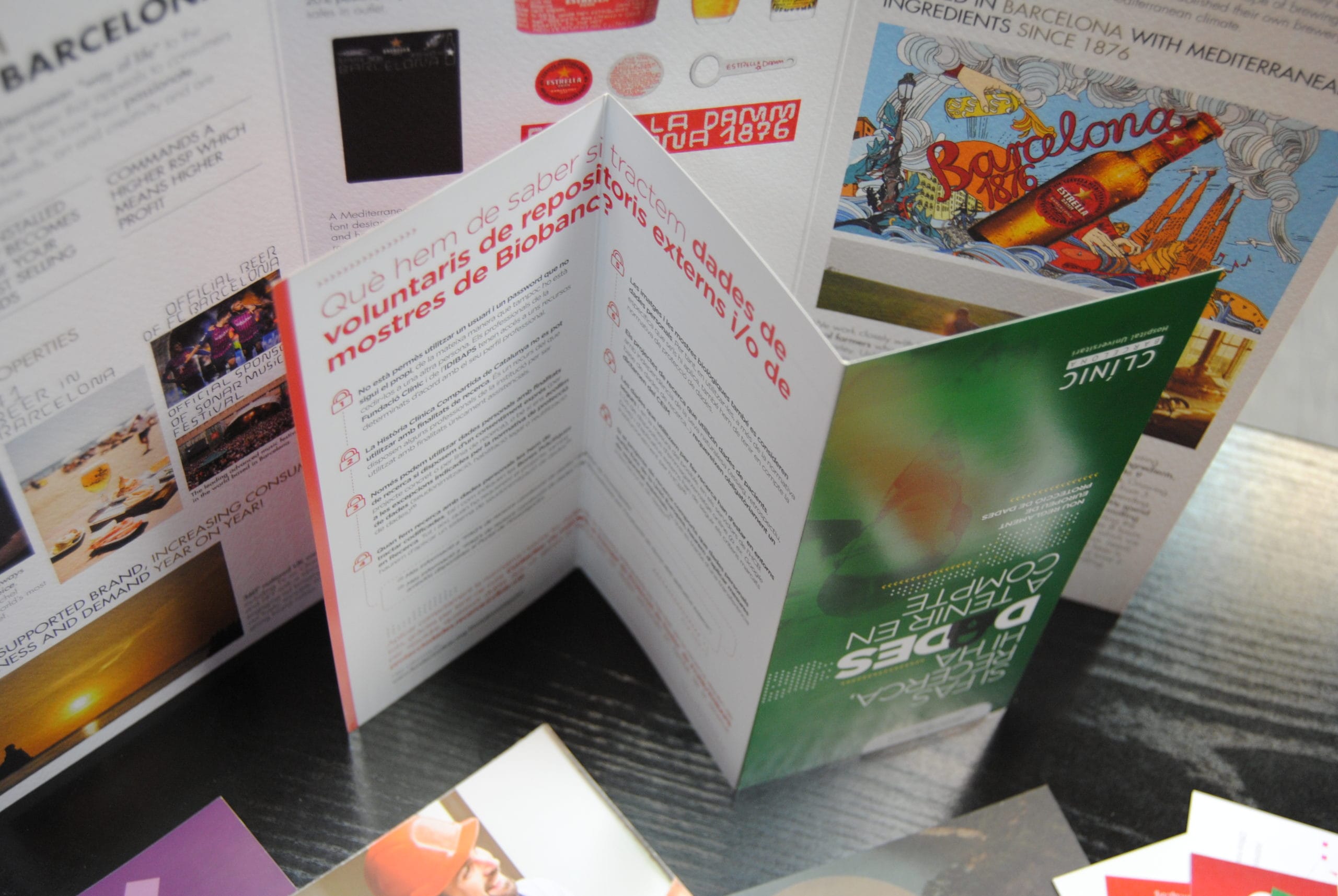

One of the most effective ways to promote your business is through brochures. This remains a highly relevant advertising strategy, combining traditional communication with modern channels. If you are considering using brochures to promote your business, here are the main options available.
Brochure options for your business
There are many types of brochures depending on the folding format. Choosing the right one depends on your business needs. Below are the most common options:
– Flyer (single sheet)
The simplest format. It consists of a single sheet printed on both sides. It is ideal when you do not need to include a large amount of information and want to present your message at a glance.
– Bi-fold brochure (folded in half)
This format divides the sheet into two panels, allowing you to include more detailed information. It is suitable for presenting menus, product ranges or general business information.
– Tri-fold brochure (three panels)
Folded into three sections, creating six panels. It is ideal for more extensive content and commonly used in museums and cultural institutions.
– Four-panel fold (quad-fold brochure)
This format divides the sheet into four sections, resulting in eight panels for content distribution.
– Multi-fold brochure
Includes more than four folds. It is recommended when your business needs to present detailed and comprehensive information.
Depending on the folding style, you can also consider:
– Cross fold
Folded in a cross pattern. Commonly used for tourist information such as city maps or guides. It can include multiple panels, similar to a booklet.
– Z-fold (accordion fold)
A series of parallel folds creating a zigzag structure. Widely used for structured information and step-by-step content.
– Gate fold (window fold)
Folds inward from both sides, like opening a window. It creates a strong visual impact when opened.
How to choose the right brochure
When selecting the most suitable brochure format, your business should consider several factors, such as budget and the amount of information to include. If in doubt, we recommend consulting with professionals to ensure the best choice.
Now that you are familiar with the available brochure formats, you can select the one that best fits your communication needs.