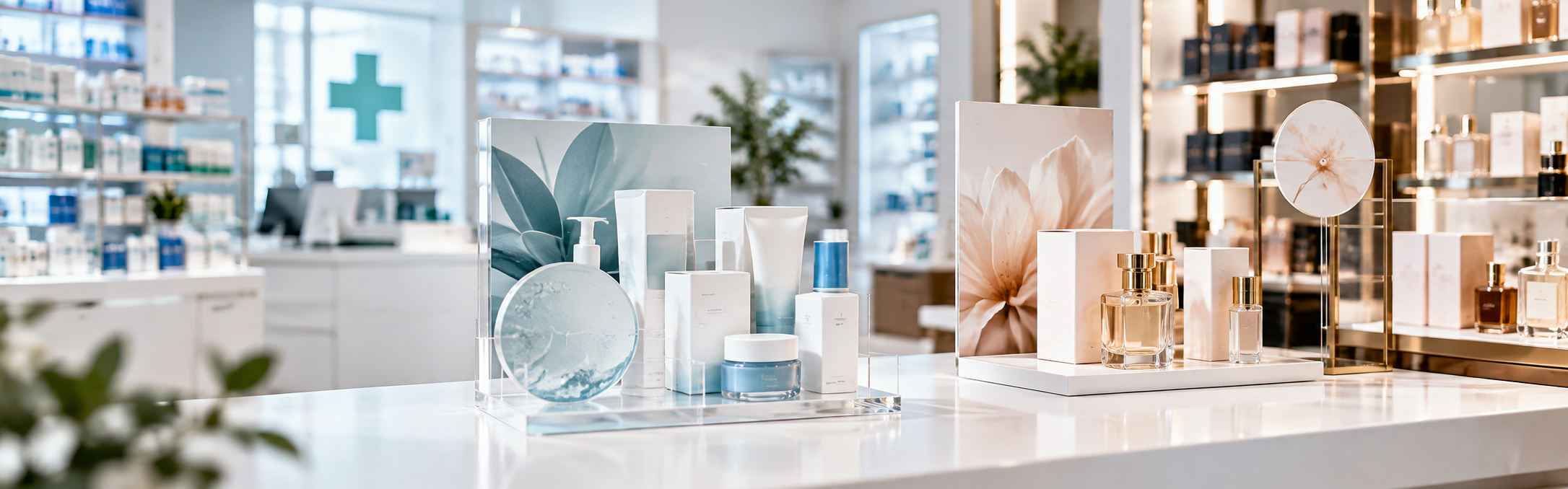

What makes pharmacy POS displays different from those used in any other retail channel?
Part of what is communicated inside a pharmacy is regulated by law. Royal Decree 1416/1994 regulates the advertising of medicinal products for human use in Spain: it is not an industry code of good practice, but current national legislation. Most print suppliers producing material for the pharmacy channel have never read it.
That is the fundamental difference. It also explains why a pharmacy campaign takes three to four weeks longer than an equivalent FMCG campaign.
Spain has 22,273 community pharmacies, according to the 2025 Statistics on Registered Pharmacists and Community Pharmacies report by the General Council of Pharmaceutical Associations. That is 70% more than all public primary care points combined.
It is a vast, highly distributed network in which each pharmacy owner also decides independently what material is accepted in their establishment.
What follows is what makes the difference in practice: what can and cannot be communicated, where the boundary lies between medicines and cosmetics, and why the same POS material that works in a perfumery can be a problem in a pharmacy.
Pharmacies and perfumeries are not the same channel: who makes the decision is the critical difference
Briefings often refer to “pharma-cosmetics” as though it were a single channel. Operationally, it is not, and confusing the two leads to costly mistakes.
| Pharmacy | Perfumery / Selective channel | |
|---|---|---|
| Number of locations in Spain | 22,273 (CGCOF, 2025) | Selective channel: 23% of the cosmetics market |
| Communication regulations | Royal Decree 1416/1994 for medicinal products | Regulation (EC) No 1223/2009 on cosmetics |
| Average floor space | Small, highly fragmented | Variable, with extensive display space |
| Who decides what is displayed | The pharmacy owner | Retail chain head office |
| Seasonality | Low, except for specific campaigns | Very high (Christmas, Mother’s Day, summer) |
| Material turnover | Long | Short, with 3–6 week campaigns |
The critical difference comes at the final stage. In perfumery, head office negotiates and the store executes. In pharmacy, each owner independently decides what material they accept in their establishment. That means 22,273 independent decisions.
This completely changes how a campaign needs to be designed. Material that is difficult to assemble, takes up too much space or offers no perceived value to the pharmacist simply will not be installed. There is no head office forcing compliance.
The following figures come from the CGCOF annual report published in June 2026:
pharmacies (42 more than in 2024)
active community pharmacists
registered pharmacists in total
average number of pharmacists per pharmacy
And the figure I find most useful for understanding the channel, because it puts its actual role into context:
The community pharmacy network is 70% larger than the public primary care network, which comprises 3,068 health centres and 9,996 local clinics. — 2025 Statistics on Registered Pharmacists and Community Pharmacies, CGCOF
Reach of the Spanish pharmacy network
CGCOF, 2025 Statistics on Registered Pharmacists and Community Pharmacies · Spanish Ministry of Health
55,098 active pharmacists
9,996 local clinics
A pharmacy is not just a sales channel: it is the country’s most accessible healthcare point. And that shapes the tone of everything communicated within it.
Aggressive promotional material of the type that works on an FMCG retail shelf clashes directly with how customers perceive that environment. It is not a matter of aesthetic taste; it is about consistency with the setting.
What Royal Decree 1416/1994 says and what it means for material design
Royal Decree 1416/1994 of 25 June regulates the advertising of medicinal products for human use. The Spanish Ministry of Health’s Guide to Advertising Medicinal Products sets out its practical application. Without entering into legal territory —that is the pharmaceutical company’s legal department’s role— there are three operational consequences that directly affect whoever produces the material:
Not all products sold in pharmacies are subject to the same regulations. An over-the-counter medicine, a food supplement, a medical device and a cosmetic product are subject to different regulatory frameworks. The same display can contain products from three different legal categories, each with its own rules on what claims can be made.
Advertising medicines to the general public is subject to specific conditions. Royal Decree 1416/1994 establishes that advertising of medicinal products must encourage their rational use, presenting them objectively and without exaggerating their properties.
The key operational distinction: advertising to the general public is only permitted for medicines that are not subject to medical prescription (known as non-prescription or self-care medicines). Prescription medicines may only be advertised to professionals authorised to prescribe or dispense them, which completely excludes material displayed in public areas of a pharmacy.
There is an additional factor that makes nationwide campaigns more complex: Spain’s autonomous communities have powers in this area and some have developed their own regulations and guidelines. Material approved for one autonomous community is not automatically approved for all seventeen.
The material must be approved before production, not afterwards. This is the practical consequence with the greatest impact on lead times. In FMCG, the final artwork goes through marketing and then into production. In pharmacy, artwork for material that includes medicines will usually also need to go through the laboratory’s regulatory affairs or scientific affairs department.
This step adds time to the schedule. A supplier that does not allow for it will plan the entire campaign incorrectly.
The real timeline of a pharmacy campaign
The following breakdown corresponds to the reference planning Artyplan applies to pharmacy-channel campaigns, compared with an equivalent FMCG campaign. It is not a published industry standard: it is our own methodology based on completed projects, which is why we share it while clearly stating its origin.
Not all products sold in pharmacies are subject to the same regulations. An over-the-counter medicine, a food supplement, a medical device and a cosmetic product are subject to different regulatory frameworks. The same display can contain products from three different legal categories, each with its own rules on what claims can be made.
Advertising medicines to the general public is subject to specific conditions. Royal Decree 1416/1994 establishes that advertising of medicinal products must encourage their rational use, presenting them objectively and without exaggerating their properties.
The key operational distinction: advertising to the general public is only permitted for medicines that are not subject to medical prescription (known as non-prescription or self-care medicines). Prescription medicines may only be advertised to professionals authorised to prescribe or dispense them, which completely excludes material displayed in public areas of a pharmacy.
There is an additional factor that makes nationwide campaigns more complex: Spain’s autonomous communities have powers in this area and some have developed their own regulations and guidelines. Material approved for one autonomous community is not automatically approved for all seventeen.
The material must be approved before production, not afterwards. This is the practical consequence with the greatest impact on lead times. In FMCG, the final artwork goes through marketing and then into production. In pharmacy, artwork for material that includes medicines will usually also need to go through the laboratory’s regulatory affairs or scientific affairs department.
This step adds time to the schedule. A supplier that does not allow for it will plan the entire campaign incorrectly.
Reach of the Spanish pharmacy network
CGCOF, 2025 Statistics on Registered Pharmacists and Community Pharmacies · Spanish Ministry of Health
Regulatory approval adds 1 to 3 weeks
This stage does not exist in FMCG and is the most common reason campaigns run late. A supplier promising FMCG lead times does not understand the channel.
The difference lies in validation, distribution and installation of the graphic material. A supplier promising the same lead times as for FMCG has either never worked in the channel or is likely to miss those deadlines.
Perfumery: the selective channel grew by 8.9% and demands premium finishes
The selective channel follows a very different dynamic. STANPA’s 2025 figures show a sector undergoing strong growth:
- Spanish cosmetics market: €11,818.86 million (+5.8% compared with 2024)
- The selective channel grew by 8.9%, above the market average
- Fragrance exceeded €2.4 billion, with growth of 9.5%
- The sector contributes more than 1% of Spain’s GDP
The selective channel’s above-average growth has a direct implication for POS producers: perfumery is investing in the in-store brand experience, which translates into more elaborate materials, premium finishes and shorter renewal cycles.
The requirements here are different:
Finishes. Foil stamping, embossing, premium materials and special inks. The material has to match the product it presents. An unfinished cardboard display in a premium fragrance corner undermines the brand it is intended to promote.
Colour accuracy. A luxury brand’s corporate colour allows no deviation. This requires colour profiling and contract proofs, not standard printing.
Concentrated seasonality. The selective channel’s Christmas campaign is produced in September and installed in November. Production peaks are intense and installation windows extremely tight.
The three most common mistakes in pharma-cosmetics campaigns
- First: treating a pharmacy like a small supermarket. It is not. The pharmacy owner decides, space is limited and the tone of communication has to be consistent with a healthcare environment. Material designed according to FMCG logic often creates resistance at the pharmacy counter.
- Second: producing without regulatory approval. I have seen complete print runs sitting in a warehouse because the artwork had not gone through regulatory approval. The cost is not just the material: it is the campaign that fails to launch on time.
- Third: using the same finishes for pharmacy and perfumery. They involve different audiences, environments and expectations. Pharmacy material prioritises clear information and ease of installation. Perfumery material prioritises finish quality and brand consistency. Standardising production to “optimise costs” often proves expensive in both directions.
Checklist before launching a pharma-cosmetics campaign
What legal category does each product in the material belong to? Medicinal product, medical device, food supplement or cosmetic. This determines what claims can be made.
Has regulatory approval time been allowed for in the schedule? Between 1 and 3 additional weeks.
Will the format fit in an average pharmacy? Display space is limited and highly contested.
Can pharmacy staff assemble it in under five minutes? If not, it will not be installed.
Is there different material for pharmacy and perfumery? If it is the same, one of the two channels has not been properly addressed.
Has a replacement percentage been planned? Across a network of more than 20,000 locations, incidents are statistically inevitable.
Frequently Asked Questions
How many pharmacies are there in Spain?
There were 22,273 pharmacies at the end of 2025, according to the General Council of Pharmaceutical Associations’ 2025 Statistics on Registered Pharmacists and Community Pharmacies report. That is 42 more than in 2024 and represents 70% more locations than the public health centres and local clinics combined.
What regulations govern advertising at the pharmacy point of sale?
Advertising of medicinal products for human use is regulated by Royal Decree 1416/1994 of 25 June. Cosmetics are governed by Regulation (EC) No 1223/2009, while medical devices and food supplements have their own regulatory frameworks. A single display can contain products from several legal categories, each with different rules regarding what claims can be made.
How long does a pharmacy POS campaign take?
Between 8 and 11 weeks from briefing to full implementation, compared with 5–7 weeks for an equivalent FMCG campaign. The difference is explained by regulatory validation of the material (1–3 weeks) and the greater distribution complexity of a highly fragmented network.
Can the same POS display be used in pharmacies and perfumeries?
It is not advisable. Pharmacy requires clear information, quick installation by pharmacy staff and a tone consistent with a healthcare environment. Perfumery requires premium finishes, precise colour accuracy and consistency with the brand’s positioning. Standardising production compromises effectiveness in both channels.
Why is it so important who makes the decision in each channel?
Because it determines the actual implementation rate. In perfumery, head office negotiates and the stores execute, making implementation high and predictable. In pharmacy, each of the 22,273 owners decides individually whether to accept the material. If the design does not add value or makes poor use of their space, it will not be installed, no matter how firmly the campaign has been agreed with the pharmaceutical company.
About the author
Sergio Triguero is Director of Strategic Marketing and Business Development at Artyplan, with more than 20 years of experience in B2B marketing, trade marketing and key account management in the graphic production sector. Artyplan has produced, stored and distributed graphic materials since 1965, with production centres in Barcelona (+5,000 m²) and Madrid (+2,000 m²), and works on campaigns for pharmaceutical and FMCG companies including Bayer, Grifols, Cantabria Labs and Nestlé.
Sources
- General Council of Pharmaceutical Associations (CGCOF) — 2025 Statistics on Registered Pharmacists and Community Pharmacies (published June 2026)
- BOE — Royal Decree 1416/1994 of 25 June regulating the advertising of medicinal products for human use
- Spanish Ministry of Health — Guide to Advertising Medicinal Products for Human Use to the General Public
- STANPA — Overview of the Cosmetics and Fragrance Industry in Spain 2025 (April 2026)
- DBK / INFORMA Sector Observatory — Perfumery and Cosmetics Distribution