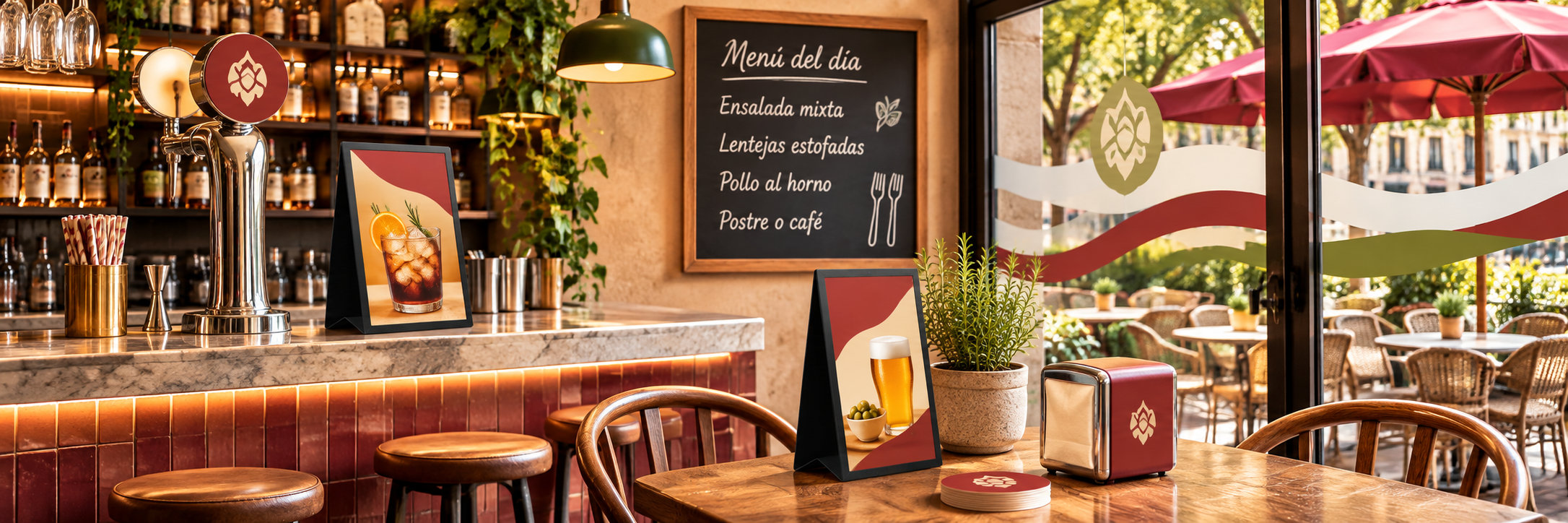

What POS display material works in bars and restaurants?
In hospitality, effective POS display material is what the venue owner accepts, displays and continues to use three weeks later: items that are useful to their business (menu holders, chalkboards, napkin dispensers, coasters, bar counter displays, window vinyl graphics and outdoor seating accessories), with integrated branding, resistant to moisture and daily cleaning, and sized so they do not take up valuable working space. While in a supermarket the brand negotiates space with the central purchasing organisation, in a bar that space belongs to the owner, who decides whether to make it available depending on what it offers them.
That difference changes everything: the format, the material, the distribution method and even what can be displayed on the street.
How many bars and restaurants are there in Spain?
According to the 2025 Spanish Hospitality Yearbook, produced by Hostelería de España using data from the INE Central Business Directory as at 1 January 2024, the sector comprises 308,256 establishments. Of these, 266,837 are food and beverage service establishments and 163,890 are bars, accounting for 53.2% of the total. There are 83,714 restaurants and cafés, and 19,233 institutional and other catering establishments.
More than half of Spain’s hospitality establishments are bars
Hospitality establishments by type as at 1 January 2024. Total: 308,256
Source: Hostelería de España, 2025 Spanish Hospitality Yearbook, using INE (DIRCE) data as at 1 January 2024. Prepared by Artyplan.
If you come across a different figure, it is not an error. Consultancy firm UVE counts 280,403 establishments in its Data Market Horeca 2025 report because it measures the commercial or traditional HoReCa channel using its own database rather than the INE directory. Either figure can be used to determine the scale of a campaign, provided they are not mixed.
By region, Catalonia has 23,781 bars and the Community of Madrid has 16,037, according to the same yearbook. They are two similarly sized markets with, as we will see, different rules for outdoor seating areas.
Beer and spirits compete at the bar
For many beverage brands, hospitality is the main sales channel. The 2025 Socioeconomic Report on the Spanish Beer Sector, published by Cerveceros de España, states that 64% of beer is consumed in hospitality venues, compared with 36% at home. The same report estimates that beer accounts for around 25% of hospitality establishments’ turnover, rising to 40% in smaller venues. For spirits, the proportion is higher: Espirituosos España estimates that 75.3% of sales by value take place in hospitality venues (2025 Socioeconomic Report).
Take care when comparing these figures: the beer figure refers to consumption volume, while the spirits figure refers to sales value. However, both point to the same conclusion: if a beverage brand is not well presented in a bar, it is absent from the place where most consumption decisions are made.
Supermarkets versus bars: five differences that change the material
| Supermarket | Bar or restaurant | |
|---|---|---|
| Who decides how space is used | The chain’s central purchasing organisation | Each individual venue owner |
| What competes with the item | Other brands on the shelf | Daily operations: plates, boxes, customers |
| Expected service life | Weeks during the promotion | Months, if the item is useful |
| Exposure to wear and damage | Contact with shopping trolleys, handling | Moisture, grease, cleaning products, sunlight in outdoor seating areas |
| Who installs it | Store staff or installers | Often the distributor’s sales representatives during their visits |
The third row highlights the most practical rule I know for hospitality: if an item is not useful to the venue owner, it disappears. A cardboard poster on a bar wall lasts only until it gets dirty. A well-made tabletop menu holder lasts an entire season, and every time a customer looks at it, they see the brand.
The fifth row highlights another rule: the kit must be designed so that a sales representative in a hurry can assemble it without tools, between lunchtime and evening service.
Can a beverage brand be displayed in an outdoor seating area?
It depends on the city, the item and the alcoholic strength of the beverage. And this is where Barcelona and Madrid differ.
In Barcelona, the Outdoor Seating Ordinance distinguishes between different types of items. Article 32 allows establishments to identify themselves on parasols and chair backs, but only using the venue’s registered company name or trading name, and prohibits the inclusion of product brands or codes. Article 33, however, allows chairs and tables to be used as advertising media, within the limits permitted by the Ordinance on the Use of the Urban Landscape. In practical terms: a beer logo on a parasol is not permitted; on a table, it depends on what the urban landscape regulations allow.
In Madrid, the new Ordinance 7/2025 on Outdoor Seating Areas and Hospitality and Catering Kiosks, published on 5 December 2025, has applied since 1 January 2026. Annex IV sets out how establishments and suppliers may be identified on outdoor seating furniture and accessories. Law 5/2002 of the Community of Madrid, meanwhile, prohibits advertising alcoholic beverages in places where their sale and consumption are prohibited, while exempting outdoor advertising of fermented beverages with an alcoholic strength of up to 20% ABV, such as beer or wine. Public streets are one of those places, with an explicit exception for outdoor seating areas and pavement cafés (Article 30). In 2011, the Supreme Court upheld this prohibition in relation to whisky advertising on street billboards. In practical terms, advertising material for a spirit that is visible from the pavement, outside the outdoor seating area, presents a problem; what is displayed on the outdoor seating furniture itself is also subject to municipal regulations.
Above both regulations is Spain’s General Advertising Law, Article 5 of which prohibits advertising beverages with an alcoholic strength above 20% ABV in places where their sale or consumption is prohibited.
The same outdoor seating area does not allow the same branding in Barcelona and Madrid
What each city permits on outdoor seating furniture and accessories in public spaces
| Barcelona | Madrid | |
|---|---|---|
| Parasols and chair backrests | Only the establishment’s registered company name or trading name. No product brands or codes (Outdoor Seating Ordinance, Art. 32). | Identification of the establishment and its suppliers is regulated by Annex IV of Ordinance 7/2025, in force since 1 January 2026. |
| Tables and chairs | May be used as advertising media, subject to the Ordinance on the Uses of the Urban Landscape (Art. 33). | Governed by Ordinance 7/2025 and its Annex IV. |
| Alcoholic beverage advertising visible from public spaces | Law 34/1988 (Art. 5): advertising of beverages exceeding 20% ABV is prohibited in places where their sale or consumption is not permitted. Regional regulations also apply. | Law 5/2002 (Art. 28): outside terraces and outdoor seating areas, only outdoor advertising of fermented beverages up to 20% ABV, such as beer or wine, is permitted. |
Source: Barcelona Outdoor Seating Ordinance (Arts. 32 and 33); Madrid Ordinance 7/2025; Law 5/2002 of the Community of Madrid (Art. 28); Law 34/1988 (Art. 5). Prepared by Artyplan. This does not replace consulting the regulations applicable in each case.
My recommendation: before designing outdoor seating materials for a campaign, decide whether they are intended for Barcelona, Madrid or both, and create two versions if necessary. A parasol that complies with regulations in one city could result in a fine for the venue owner in another, and the owner will not forget it. The ordinances also contain specific regulations for individual streets and areas, so for large campaigns it is advisable to check with the local council or hospitality trade association.
Which materials withstand hospitality environments?
Before choosing a material, ask where the item will be used.
| Area of the premises | What damages the material | What tends to work |
|---|---|---|
| Bar counter and indoor tables | Liquids, grease, cleaning several times a day | Laminated or plastic-coated rigid materials, rounded edges, no exposed cardboard |
| Windows and doors | Sunlight, condensation, cleaning products | Printed self-adhesive vinyl, laminated if applied to the exterior surface |
| Chalkboards and menus | Constant use, changes to the menu or offers | Rigid materials with an area that the venue operator can update |
| Outdoor seating area | Sunlight, rain, wind, daily stacking | Technical textiles or outdoor-grade rigid materials; nothing that can blow away or obstruct access |
| Cold rooms and refrigerators | Low temperatures, moisture, door impacts | Vinyl graphics and adhesives designed for low temperatures |
Two common mistakes. The first is using the same lightweight cardboard in hospitality as in supermarket promotions. The second is forgetting that venue owners change their offering: a chalkboard or menu that cannot be updated ends up in storage.
How to reach thousands of venues without losing control
A supermarket receives campaign materials through its central distribution network. A bar does not: each venue is an independent destination, with challenging delivery hours and no loading bay. That is why, in hospitality, campaign logistics are just as important as design.
There is one feature of this channel that does not exist in supermarkets. According to Cerveceros de España (2025), 82% of the beer sold through hospitality venues is served in reusable containers, either kegs or returnable bottles. This means distributors regularly visit bars to deliver and collect containers, making these visits the ideal opportunity to deliver or replenish point-of-sale materials, provided the kit fits into their delivery route.
The most effective approach is to work with kits tailored to each type of venue (neighbourhood bars, restaurants, beach terraces and nightlife venues), labelled so that the sales representative or distributor knows which venue each kit is intended for, with replacement stock for the items most exposed to wear and tear. We explain this in detail in campaign kitting: how the right material reaches each point of sale.
How we do it at Artyplan
At Artyplan, we produce POS display material and point-of-sale materials for food and beverage brands, including bar counter displays, self-adhesive vinyl graphics for windows and the promotional material that accompanies each campaign. We prepare materials by venue type through our warehousing, order picking and logistics service from our Barcelona and Madrid production centres, and if the campaign requires it, we also handle installation.
If you work in large-scale retail, the companion guide is types of POS display material for supermarkets. What works there rarely works unchanged at a bar counter.
Frequently Asked Questions
How many bars are there in Spain?
According to the 2025 Spanish Hospitality Yearbook, using INE data as at 1 January 2024, there are 163,890 bars, representing 53.2% of the country’s 308,256 hospitality establishments. Catalonia has 23,781 bars and the Community of Madrid has 16,037.
What percentage of beer is consumed in hospitality venues?
64%, according to the 2025 Socioeconomic Report on the Spanish Beer Sector by Cerveceros de España; the remaining 36% is consumed at home. Beer accounts for around 25% of hospitality establishments’ turnover.
Can a beer logo be displayed on a parasol in an outdoor seating area in Barcelona?
In outdoor seating areas subject to Barcelona’s Outdoor Seating Ordinance, Article 32 only allows the venue’s registered company name or trading name to appear on parasols and chair backs, without product brands or codes. Tables and chairs may be used as advertising media under Article 33, within the limits established by the Ordinance on the Use of the Urban Landscape.
Can an alcoholic beverage be advertised in an outdoor seating area in Madrid?
Law 5/2002 of the Community of Madrid prohibits advertising alcoholic beverages in places where their sale and consumption are prohibited, such as public streets, except for outdoor seating areas and pavement cafés. It exempts outdoor advertising of fermented beverages with an alcoholic strength of up to 20% ABV, such as beer, from this prohibition. Materials displayed on outdoor seating furniture and accessories are also governed by Ordinance 7/2025, which has been in force since 1 January 2026.
Which POS display material lasts longest in a bar?
Materials that withstand moisture and daily cleaning while also being useful to the venue owner: menu holders, chalkboards that can be updated, napkin dispensers or bar counter displays made from laminated rigid substrates. The lightweight cardboard used in supermarket promotions tends not to last long at a bar counter.
About the author
Sergio Triguero is Artyplan’s Director of Strategic Marketing and Business Development. He has more than 20 years’ experience working with brands and agencies to ensure their campaigns reach the point of sale with the quality, timing and consistency they require. Artyplan has been producing graphic materials since 1965 at its Barcelona and Madrid production centres.
Sources
- Hostelería de España, 2025 Spanish Hospitality Yearbook
- Cerveceros de España, 2025 Socioeconomic Report on the Spanish Beer Sector
- Espirituosos España, 2025 Socioeconomic Report (summary in Vinetur, 8 July 2026)
- UVE, Data Market Horeca 2025 (summary in Merca2)
- Barcelona City Council, Outdoor Seating Ordinance
- Madrid City Council, Ordinance 7/2025 on Outdoor Seating Areas and Hospitality and Catering Kiosks
- BOE, Law 5/2002 of the Community of Madrid on Drug Dependence and Other Addictive Disorders
- Law 34/1988, General Advertising Law, Article 5
- Legal Today, the Supreme Court upholds the ban on advertising alcoholic beverages on billboards (2011)