


What is white-label graphic production?
White-label graphic production is an arrangement in which a supplier manufactures, stores, delivers and even installs an agency’s materials without its name appearing in front of the agency’s client: not on the packaging, the delivery note or the installation team. There is one exception: personal data. In that case, the brand has the right to know who processes the data and to authorise them. For the model to work, the supplier should guarantee five things in writing: commercial invisibility, enforceable confidentiality, GDPR compliance, cover for physical risk and clean invoicing.
That unbranded box is the easy part. The other four guarantees are what protect the agency when something goes wrong.
Why does this model exist? Because most agencies do not have their own production facilities. As at 1 January 2025, Spain had 50,574 advertising businesses (CNAE group 731, which also includes media representation), and 97.6% had fewer than ten employees; 73.1% had none, compared with 54.4% of Spanish businesses overall (our calculation based on the INE Central Business Directory). In practice, the graphic production supplier acts as the agency’s production department.
Why is neutral shipping not enough?
Because neutral shipping only hides the sender: it does not cover confidentiality, data, damage or invoicing. And agencies work on tight margins. In 2024, advertising agencies (CNAE 7311) purchased goods and services equivalent to 70.7% of their turnover, while their gross operating rate was 10.0%, according to the INE Structural Business Statistics (the purchasing percentage is our own calculation). Trade show and convention organisers are close behind, with purchases of 69.2%.
Seven out of every ten euros billed by an advertising agency are paid to third parties
Purchases of goods and services as a percentage of turnover, 2024 (%). Includes media space, production, rentals and supplies.
Source: own calculation based on INE, Structural Business Statistics: Services Sector 2024 (table 36179). Produced by: Artyplan.
Those purchases include media space, rentals and supplies, not just production. Even so, the practical conclusion still holds: if around 10 cents of gross operating surplus remain from every euro billed, an unbudgeted reprint is not paid for by the client. It comes out of the agency’s margin. In group 731 (which includes media representation), gross operating surplus represents 12.1% of turnover for businesses with 2 to 9 employees and 7.9% for those with 10 to 19 (our calculation using the same statistics).
Almost all online printers serving resellers offer the same thing: neutral shipping, unbranded packaging and a promise not to contact your clients. That is the minimum. None of those we reviewed explains what happens with confidentiality, personal data, damaged materials or payment terms.
Guarantee 1: make sure your client does not see the supplier (and the supplier does not pursue your client)
That invisibility must cover everything that comes into contact with the end client, not just the box:
- Packaging, labels and delivery notes without the supplier’s branding, or using the agency’s details.
- Delivery and installation documentation issued in the agency’s name.
- An installation team that presents itself as part of the agency’s project.
- Communication with the end client only through the agency, unless the agency decides otherwise.
The second half is the more important one, and I would rather address it directly. At Artyplan we also work directly for brands, so I understand the question an agency asks before handing a client over to any supplier: are you going to take my client? What you should ask any supplier for is a non-contact and non-solicitation clause, including its duration and consequences, together with a list of the brands the supplier already works with directly, declared before the first order. That way, trust no longer depends solely on goodwill.
Guarantee 2: how do you protect your client when you subcontract printing?
With a confidentiality agreement and, above all, measures that you can prove. Law 1/2019 on Trade Secrets requires the information to be secret, to have commercial value and to have been “subject to reasonable steps by its lawful holder to keep it secret”. Without those measures, there is no trade secret to enforce.
For an agency, the information that can be protected is specific: the client’s identity before a launch, unpublished artwork, prices and the campaign schedule. Disclosing a trade secret in breach of a confidentiality agreement is unlawful under the law, but the agency must be able to prove that it took protective measures. Ask the supplier to implement them too:
- Restrict file access to people working on the project.
- Use a project code name in production and warehousing.
- No use of the material in portfolios, social media or case studies without written permission.
- Delete or return files when the project closes.
Guarantee 3: does the agency need a data processing agreement with the printer?
Yes, whenever the order contains personal data: personalised mailings, named credentials, labels containing customer data or any variable-data printing involving individuals. This is where white-label production has a legal limit that should be understood before making promises to the client.
Under Article 28 of the GDPR, the relationship between the party deciding how personal data is used and the party processing it on its behalf must be formalised in writing. Normally, the brand is the controller, the agency is the processor and the printer is the subprocessor. When subcontracting, the Spanish Data Protection Agency guidelines state that “the GDPR requires the controller’s prior written authorisation”. This may be specific or general authorisation, with prior notice so that the brand can object. If the subprocessor fails to comply, “the initial processor shall remain fully liable”.
In practical terms: the supplier may be invisible to the public, but it cannot be kept secret from the brand acting as data controller.
There is an official model that helps protect the agency. Under the European Commission’s standard contractual clauses (Implementing Decision (EU) 2021/915), if the brand asks for a copy of the contract with the subprocessor, the agency must provide it, but may “redact the text of the contract before sharing the copy” so that commercial secrets such as the supplier’s rates are not disclosed. The agreement must also provide for the deletion or return of the data at the end of the processing.
This is not merely theoretical. Years ago, the AEPD classified a company that labelled, enveloped and sent mailings on behalf of third parties as a data processor (legal report 0309/2008, issued under the previous legislation). Every case has its own nuances, so check the roles with your data protection officer or adviser.
Guarantee 4: who is responsible if the material reaches the agency’s client damaged?
Each link in the chain is liable to the party that contracted it: the supplier to the agency and the agency to its client. The weakest link is transport. For road transport within Spain, Law 15/2009 limits the carrier’s compensation for loss or damage to one third of the daily IPREM for each kilogram of gross weight: using the IPREM applicable in October 2026, approximately €6.67 per kilogram (our calculation). A 300 kg pallet of displays would therefore be covered for no more than approximately €2,000.
If the contents of that pallet are worth more, somebody else must cover the difference. That is why three questions should be settled in writing before the first shipment:
- 1. Who contracts the transport? If the supplier contracts it, the agency claims against the supplier and the supplier claims against the carrier.
- 2.Who requests the declaration of value? The law allows the liability limit to be exceeded by declaring the value or a special interest in delivery and paying an additional charge. Someone needs to request it.
- 3. What is the replacement lead time? If the damage occurs within the supplier’s chain, replacement or reprinting should be at its expense, within an agreed timeframe.
What to do at the loading bay when materials arrive damaged, including claim deadlines and how much the carrier pays for a banner, is explained in urgent event printing: what to do if your graphics arrive damaged.
Guarantee 5: who invoices whom, and on what payment terms?
The supplier invoices the agency, never its client, and uses descriptions that do not reveal the supplier if the invoice forms part of a wider client file. The agency should also understand Spain’s late-payment legislation, because it protects the agency as a creditor of its client while binding it as a debtor to its supplier.
Law 3/2004 applies to transactions between businesses and professionals, including “between main contractors and their suppliers and subcontractors”. By default, the statutory payment period is 30 days from delivery of the goods or provision of the service. It may be extended by agreement, but “under no circumstances” beyond 60 calendar days. The same limit applies to the time the brand takes to pay the agency. If the deadline is breached, the creditor may claim the ECB interest rate plus eight percentage points and €40 in recovery costs.
The chain will also become more transparent. Under Royal Decree 238/2026, electronic invoicing between businesses and professionals will become mandatory, and the recipient will have to report the effective payment date within four calendar days; the Spanish Tax Agency will pass this data to the State Observatory for Private-Sector Late Payment. Its application is deferred until 12 or 24 months after the ministerial order, depending on turnover, but it will give agencies dated evidence of how long their clients take to pay.
What should a printing supplier guarantee to an agency in writing?
Five guarantees, five documents, each with supporting evidence:
| Guarantee | What to request in writing | Legal basis |
|---|---|---|
| Commercial invisibility | Unbranded packaging, delivery notes and installation; non-contact, non-solicitation and a list of brands with an existing relationship | Contract between the parties |
| Confidentiality | NDA plus safeguards: access controls, project code name, no portfolio use, file deletion | Law 1/2019, Art. 1.1(c) |
| Personal data | Data processing agreement, authorisation for subprocessors and deletion on completion | GDPR, Art. 28; Decision 2021/915 |
| Physical risk | Who contracts the transport, declaration of value and replacement lead time | Law 15/2009, Arts. 57 and 61 |
| Invoicing | Invoice only to the agency and payment within a maximum of 60 days at each stage of the chain | Law 3/2004, Arts. 3 and 4 |
What you see of white-label production is the small part
What neutral shipping covers and what must be signed between the agency and its graphic production supplier.
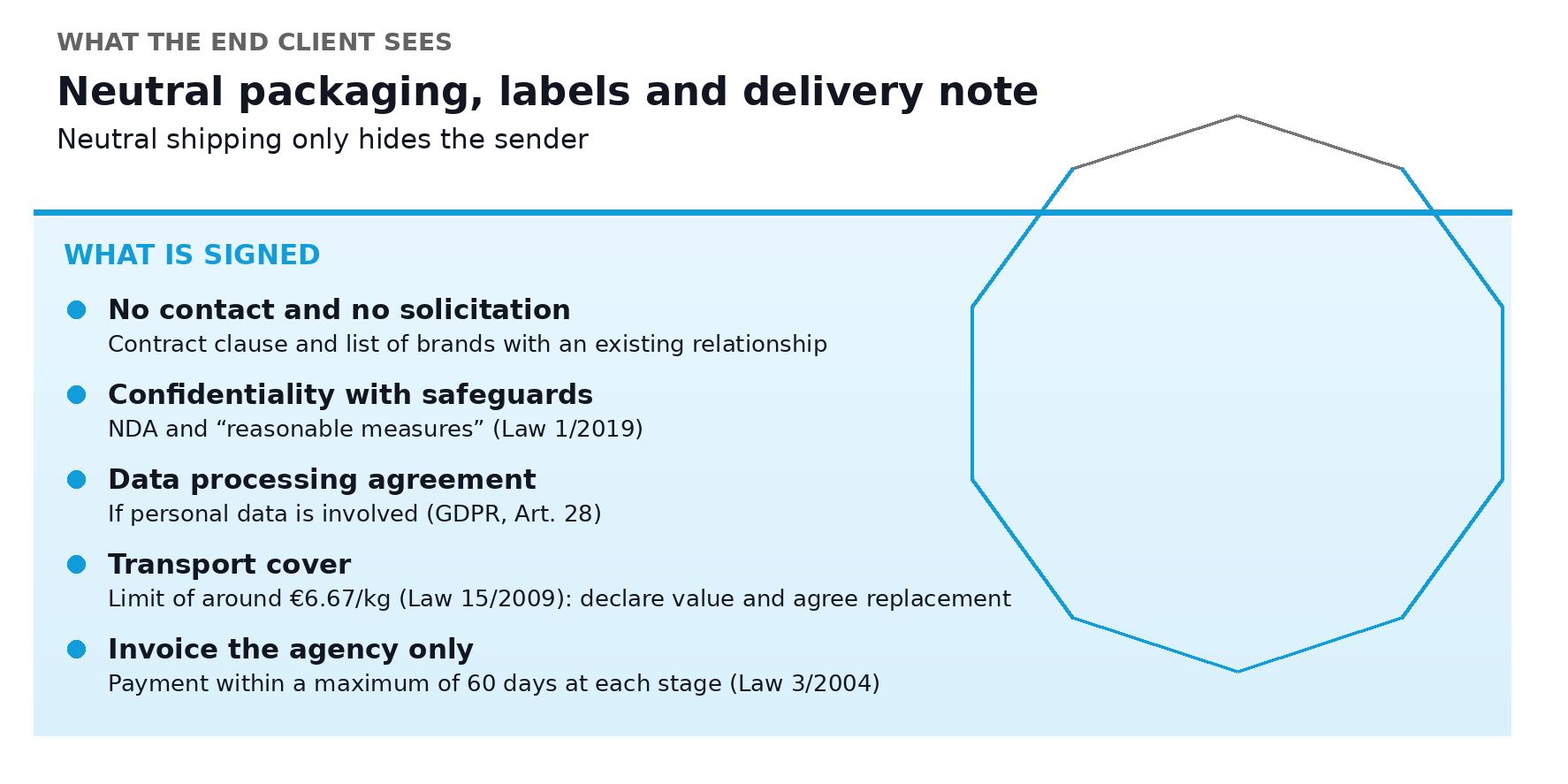
Source: Law 1/2019, GDPR (Art. 28) and Implementing Decision (EU) 2021/915, Law 15/2009 (Art. 57) using the IPREM applicable in October 2026, Law 3/2004. Produced by: Artyplan.
My advice, after many years working with agencies: ask for these documents before the first order, not after the first problem.
At Artyplan, we provide white-label printing for agencies with graphic production, warehousing, picking and logistics and installation from our Barcelona and Madrid production centres, including exhibition stand graphics and printing for events and trade shows that many agencies deliver under their own brand. General information only, not legal advice. Check your particular case with your adviser or data protection officer.
Frequently Asked Questions
What is white-label printing for agencies?
It is a service in which a supplier produces, delivers and, where necessary, installs graphic materials for an agency without the supplier’s name appearing in front of the end client. In addition to neutral packaging, it should include confidentiality, GDPR compliance, damage cover and a non-solicitation clause.
What should a printing supplier guarantee to an agency?
Five things in writing: the supplier must remain invisible to and avoid contacting the end client; confidentiality must be backed by real safeguards; a data processing agreement is required where personal data is involved; damaged material must be covered and replaced; and invoices must be issued only to the agency, with payment due within a maximum of 60 days.
How do I protect my client if I subcontract printing?
By signing a confidentiality agreement backed by reasonable safeguards (restricted access, code names, no portfolio use and file deletion), a non-contact and non-solicitation clause and, where personal data is involved, a data processing agreement authorised by your client.
Who is responsible if the material reaches the agency’s client damaged?
Each link in the chain is responsible to the party that contracted it: the supplier to the agency and the agency to its client. Because the carrier has a statutory liability cap per kilogram, the agency should agree with the supplier who contracts the transport, whether the value will be declared and how quickly damaged material will be replaced.
Do I need a data processing agreement with the printer?
Yes, if the printer processes personal data on behalf of the agency or its client, for example for mailings, credentials or labels containing personal data. If your client is the controller and your agency is the processor, you also need the client’s written authorisation to subcontract the printer.
About the author
Sergio Triguero is Artyplan’s Director of Strategic Marketing and Business Development. He has more than 20 years’ experience working with brands and agencies to ensure their campaigns reach the point of sale with the quality, timing and consistency they require. Artyplan has been producing graphic materials since 1965 at its Barcelona and Madrid production centres.
Sources
- INE, DIRCE, table 39371 (companies as at 1/1/2025)
- INE, DIRCE 2025 press release
- INE, Structural Business Statistics: Services Sector 2024, table 36179
- INE, EEE-SS 2024, table 36182 (indicators)
- INE, EEE-SS 2024, table 36180 (by size)
- AEPD, Guidelines for contracts between controllers and processors
- AEPD, legal report 0309/2008
- GDPR, Regulation (EU) 2016/679
- Implementing Decision (EU) 2021/915
- BOE, Law 1/2019 on Trade Secrets
- BOE, Law 3/2004 on late payment (consolidated)
- BOE, Royal Decree 238/2026 on electronic invoicing
- BOE, Law 15/2009 on the land transport contract
- BOCM 16/01/2026 (current IPREM)