
How much does a custom cardboard display cost?
A floor-standing cardboard display with custom graphics based on a standard model costs between €40 and €79 per unit, excluding VAT, for runs of 10 to 25 units, according to publicly available prices from Spanish manufacturers consulted on 20 October 2026. Countertop displays start at €9.50 for 50 units. These are catalogue prices for short runs, excluding transport, assembly and replenishment. They are useful as a guide, but not for budgeting. To put it plainly: if someone gives you a price per display without asking how many stores you have, how much your product weighs and whether the display travels full or empty, they are giving you a number, not a price.
| Format (standard model with your graphics) | Reference run | Published unit price |
|---|---|---|
| Countertop | 50 units | From €9.50 |
| ¼-pallet floor display | 10 units | €40.50-65.30 |
| 4-shelf floor display | 10 units | €48.76-63.12 |
| Supermarket floor display, 4 levels and 136 cm | 10 units | €57.02-78.51 |
| 180 cm totem | 10 units | From €48 |
| Unprinted structure | Single unit | €23.90-37.50 |
Source: public prices from four Spanish websites, consulted on 20/10/2026. Excluding VAT, except for one price list that does not state whether VAT is included. The price ranges depend on the finish (kraft or white) and the printing method.
Be careful about using this table as an anchor in a negotiation. A bespoke display designed for 300 stores is priced differently, and for runs of hundreds or thousands of units the unit price changes completely. The last row is more useful: compared with the previous ones (they are different models and sellers, so use it with caution), it helps separate the cost of the structure from the additional cost of printing and preparation.
What affects the price of a POS display?
Five variables. Three relate to manufacturing (print run, structure and printing); the other two are the format and everything that happens after production.
- Print run. Every die-cut display carries fixed costs, such as structural design, the mock-up and the cutting die, which do not depend on the number of units. With 10 units, those costs are spread across 10; with 1,000, across 1,000. That is why short runs use digital cutting without a die, while on long runs the die cost is amortised. The “no die cost” advertised by many websites applies to the former, not the latter.
- Structure. Corrugated board is selected first by flute type and grammage, and then by design. According to a study published in Sensors (2023), E flute is around 1.6 mm thick, B around 3 mm, C around 4 mm and A around 5 mm. One of the price lists consulted, for example, uses 502 g/m² kraft E microflute for a four-shelf display. Standard models state load capacities of 10 to 20 kg per shelf: if your product is in glass or is liquid, the structure needs to be upgraded, and the price increases too.
- Printing. Printing digitally directly onto the board does not require printing formes, so it is more cost-effective for short runs and series with variations by store. With litho-laminated offset printing (printing on paper and laminating it onto the corrugated board), the unit cost falls as the run length increases.
- After production.Flat-packed transport, storage, preparation by store, assembly and replenishment: we cover these further below.
- Format. A countertop display uses only a fraction of the material required for a floor-standing display, while a pallet display requires a load-bearing structure.
If the design is bespoke, it is best for the structural design to be carried out by the company that will manufacture it. When properly calculated, a display uses less material and can be assembled without tools. The most common formats can be found in the advertising displays and display units catalogue.
Why has the price of cardboard risen, and why is it not coming down?
It rose with paper between 2021 and 2022, and then fell much less than paper. According to Spain’s INE Industrial Price Index, manufacturing prices for corrugated board and corrugated packaging (CNAE 17.21) rose by 30.5% between January 2020 and their peak in November 2022. In August 2026 they were still 28.3% above January 2020 and only 1.7% below that peak (Artyplan calculations based on INE data; August 2026, provisional).
That explains a conversation that comes up repeatedly in procurement. Base paper (CNAE 17.12) did fall: by 19.5% between its October 2022 peak and December 2023 (Artyplan calculations based on INE data). Measured from its own peak in November 2022, corrugated board and corrugated packaging had fallen by only 5.6% by December 2023. The raw material became cheaper; the converted product barely did. That is why the argument that “cardboard prices have already fallen” does not work at the negotiating table.
There is also a warning sign in 2026. Between February and August, paper rose by 6.4%, while corrugated board passed on only 1.6% (Artyplan calculations based on INE data; June-August figures provisional). In August, industrial energy prices were 33.3% higher than a year earlier, according to the INE IPRI release. The paper industry association puts it plainly: “Our industry competes with energy costs far higher than those in neighbouring markets”, according to Manuel Domínguez, Director General of ASPAPEL (July 2026).
Whether that pressure will feed through into 2027 budgets is a hypothesis, not a fact. Even so, if you are planning campaigns for the first half of the year, I would lock in the material and price before the end of the year. One point to avoid mixing figures: the overall IPRI rose by 13.2% year on year in August 2026, the highest rate since December 2022, driven by energy. That month, corrugated board was up just 0.9%.
Paper fell after 2022; corrugated board barely did
Industrial price index, domestic market, base 2021 = 100. January 2019 to August 2026; June-August 2026 figures provisional (p).
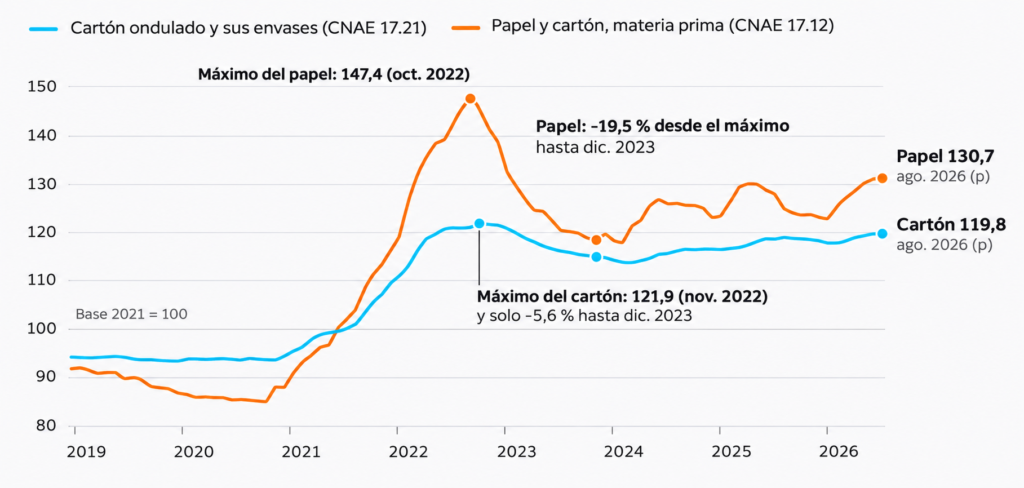
Source: INE, Industrial Price Index, base 2021, table 61525 (June-August 2026, provisional).
Compiled by Artyplan.
How long does it take to manufacture a cardboard display?
From 12 working days to around three weeks from design approval, plus the mock-up and approvals from your brand and the retailer. Spanish manufacturers that publish lead times refer to around 5 days for a physical mock-up and 12 working days for production after design and prototype approval, or around 3 weeks from final approval. These are market figures, not a universal standard.
The “quote within 24-48 hours” shown on almost every website refers to the quotation turnaround, not the manufacturing lead time. The two should not be confused when planning a campaign schedule, which has more stages than manufacturing alone:
| Stage | Estimated lead time | What can extend it |
|---|---|---|
| Brief and structural design | Depends on the project | Product dimensions and weight not finalised |
| White mock-up and prototype | Around 5 days | Format changes after reviewing the mock-up |
| Brand and retailer approval | Depends on each head office | Purchasing departments’ own approval schedules |
| Production | From 12 working days to 3 weeks | Print run, litho-laminated offset printing, special finishes |
| Preparation by store | Depends on the number of kits | Different kits by retail brand or store size |
| Transport and installation | Depends on the destinations | Number of points of sale and in-store assembly |
Source for lead times: Spanish manufacturers’ websites (consulted on 20/10/2026).
In multi-site campaigns, the final stage often has a greater impact than production itself. We explain this in how to manage POS display campaigns across more than 100 stores.
Does a cardboard display pay the plastic tax or packaging charges?
Cardboard itself is not subject to the special tax on non-reusable plastic packaging. However, the display’s plastic components (trays or hooks) may be subject to the tax at €0.45 per kilogram of non-recycled plastic when the display is supplied together with the goods.
Two details that are rarely explained. The definition of packaging in Law 7/2022 (Article 68.1.a) is broader than the definition in the packaging regulations: it includes articles that, although they do not fall within that definition, perform the same functions. The Spanish tax authorities applied this interpretation in binding ruling V0806-23, concerning clothes hangers, stating that “the definition of packaging for tax purposes is broader”. Article 73.d, meanwhile, excludes products that may contain goods but “are not designed to be supplied together” with them.
We have not found any DGT ruling specifically concerning displays (as of 20 October 2026). What follows is a practical interpretation that you should validate with your tax adviser:
| Case | Plastic tax | Packaging regulations |
|---|---|---|
| 100% cardboard display | Does not apply | Depends on whether it travels with the product |
| Pre-loaded display with plastic trays or hooks | The plastic component may be subject to the tax | May fall within the definition of grouped packaging |
| Display supplied empty and filled in store | Probably not subject to the tax (Art. 73.d) | Functions as store furniture |
We are talking about cents: with 200 grams of virgin PET per display, the tax would amount to €0.09 per unit (illustrative calculation). Classification matters more. Under Royal Decree 1055/2022, grouped packaging is packaging designed “to constitute at the point of sale a grouping of a certain number of sales units”, and a display box that arrives filled with product may fall within this definition. If it qualifies as packaging, it may also carry extended producer responsibility obligations (joining a collective scheme and filing declarations), which should be confirmed with your adviser. Since 12 August 2026, the European Packaging Regulation has also been fully applicable in Spain and, where there is a conflict, takes precedence over national rules, according to the MITECO clarification note.
Article 75 of Law 7/2022 also exempts plastics intended for the presentation of single-use packaging for medicines, medical devices or foods for special medical purposes, subject to a prior declaration by the purchaser. Whether this exemption extends to a display is a matter of interpretation. If you work with POS displays for pharmacies and perfumeries, check this before finalising the material.
My recommendation: decide in the brief whether the display will travel full or empty. It changes the classification, the obligations and, sometimes, the material.
The costs that do not appear in the quoted price
A display price usually covers the structure and printing. Everything else is additional, and the INE index itself excludes it: the IPRI measures “ex-factory selling prices, excluding transport and marketing costs”.
The catalogue price only covers the first layer of a display’s cost
Cost layers in a cardboard display campaign. Qualitative diagram: the weight of each layer depends on the print run, the number of points of sale and the service contracted.
Source: INE, Industrial Price Index metadata (prices “at factory gate, excluding transport and marketing costs”); Law 7/2022 and Royal Decree 1055/2022. Compiled by Artyplan.
Think about a campaign across 300 stores: the cheapest display can end up being the most expensive if it arrives flat-packed at stores with no staff to assemble it, or if a second shipment has to be sent because nobody planned for replenishment. That is why, in a tender, you should ask for the price per point of sale served, not per unit manufactured. It is the first of the most common mistakes when tendering POS display campaigns.
When the same supplier manufactures, stores, prepares orders by store and installs them, the costs can be compared line by line. At Artyplan, we do this from our Barcelona and Madrid production centres, with warehousing, picking and logistics and POS display installation services.
Seven pieces of information your supplier needs to give you a price that will not change
Format and dimensions, including the number of shelves.
Product weight per shelf and whether it is fragile.
Total print run and number of points of sale.
Printing and finish: digital or offset, varnish, kraft or white.
Whether the display travels full or empty and whether it includes plastic components.
Destinations, in-store implementation date and whether installation is required.
Whether replenishment will be required and at what percentage.
With these seven pieces of information, the budget for your POS display material stops being a price range and becomes a figure you can confidently present to management.
Frequently Asked Questions
How much does a custom cardboard display cost?
According to publicly available prices on Spanish websites (October 2026), a floor-standing display with custom graphics based on a standard model costs between €40 and €79 per unit for runs of 10 to 25 units, while a countertop display starts at €9.50 for 50 units. For larger runs or bespoke designs, pricing is calculated differently.
Does the price of a cardboard display include transport and assembly?
Usually not. Catalogue prices cover the structure and printing. Transport, storage, preparation by store and assembly are all quoted separately. That is why it is better to compare the price per point of sale served.
Which is more cost-effective for a cardboard display: digital printing or offset?
For short runs or versions that vary by store, direct digital printing is usually more cost-effective, as it requires no printing formes or cutting die when digitally cut. For long runs, litho-laminated offset printing and die-cutting reduce the unit cost.
How much weight can a cardboard display shelf support?
The standard models published by Spanish manufacturers state load capacities of between 10 and 20 kg per shelf. For heavy products or glass containers, the structure must be reinforced with a different flute or board weight.
Does a cardboard display pay the plastic tax?¿Cuánto cuesta un expositor de cartón personalizado?
Cardboard itself does not. Components made from non-recycled plastic may be taxed at €0.45 per kilogram if the display is supplied together with the goods. We have not found any DGT ruling specifically concerning displays, so this should be confirmed with a tax adviser.
About the author
Sergio Triguero is Artyplan’s Director of Strategic Marketing and Business Development. He has more than 20 years’ experience working with brands and agencies to ensure their campaigns reach the point of sale with the quality, timing and consistency they require. Artyplan has been producing graphic materials since 1965 at its Barcelona and Madrid production centres.
Sources
- INE, Industrial Price Indices, base 2021, table 61525
- INE, IPRI press release, August 2026
- INE, IPRI operation metadata
- AEAT, taxable base and rate for the plastic packaging tax
- AEAT, exemption cases
- AEAT, IEPNR Questions and Answers (2022)
- DGT, binding ruling V0806-23 (text reproduced by CEF; verify against petete)
- BOE, Royal Decree 1055/2022 (consolidated)
- MITECO, clarification note on Regulation 2025/40 and Royal Decree 1055/2022 (19/05/2026)
- ASPAPEL, press release 14/07/2026
- Rogalka, Grabski and Garbowski, Sensors 23 (2023) 6242
- Public prices from four Spanish websites (consulted 20/10/2026; URL in the dossier, do not link from the blog)