
Arnau Forasté Sans
Operations Director / COO of Artyplan
What is kitting in a point-of-sale campaign?
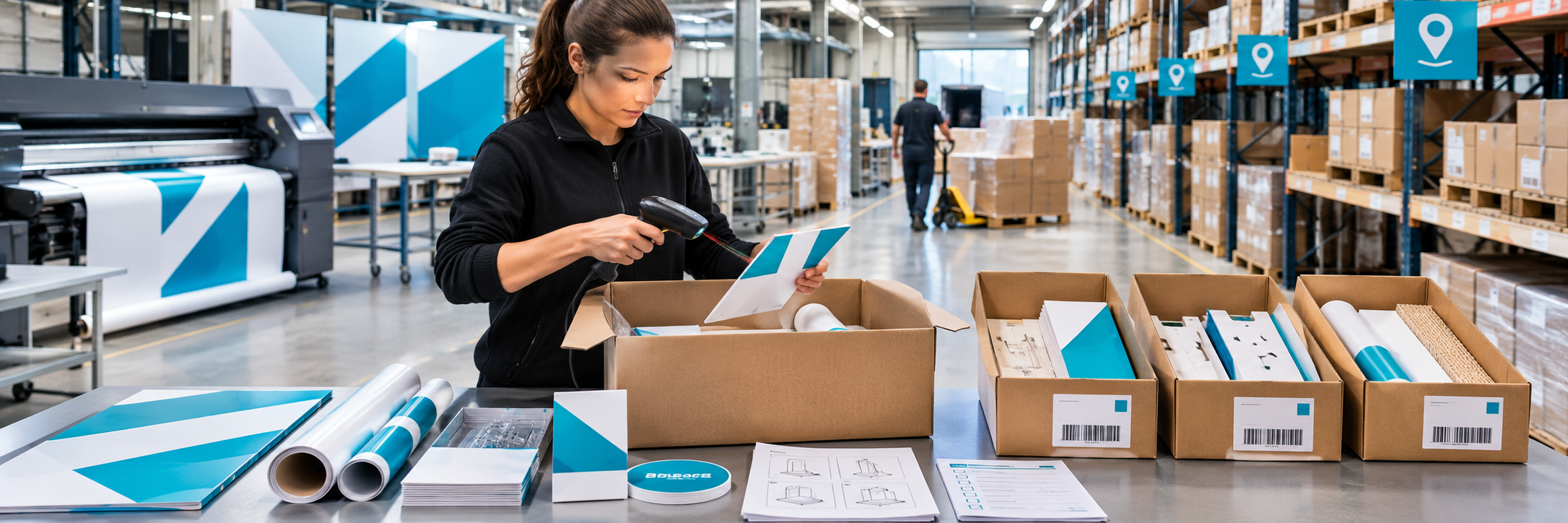
Campaign kitting involves preparing a sealed package for each store, containing all the items that particular point of sale needs (posters, shelf stoppers, vinyl graphics, displays and installation instructions), identified by its destination code and ready for installation without opening other boxes. While picking collects individual items from the warehouse according to an order, kitting brings them together into a complete package and seals it. In a campaign across 300 stores, picking tells you there are 2,400 shelf stoppers on the warehouse shelf; kitting determines which ones go to store 187, in what order and with which label.
It may seem like a minor warehousing distinction. It is not for the person signing off the campaign.
| Operation | What it does | What it solves | What it does not solve |
|---|---|---|---|
| Picking | Retrieves the items required for an order from stock | Ensures the items leave the warehouse | Ensuring each store receives its exact combination of items |
| Kitting | Groups the items for a specific destination into a single package | Allows the store to open a single box and install the materials | Ensuring the combination is correct if the store database is inaccurate |
| Finishing | Folds, inserts into envelopes, shrink-wraps and labels | Presentation and protection of each item | The composition of the kit |
Why do campaigns fail at the kitting stage rather than at the printing stage?
Because the kit is where three lists intersect that almost never come from the same department: the marketing campaign plan, the sales department’s store database and production stock. From an operations perspective, I see it this way: when a rollout fails, it is rarely because of a colour or a cutting die. The problem is that a neighbourhood store receives a 180 cm vinyl graphic intended for a hypermarket, or a shelf stopper in Catalan is sent to Zaragoza.
A printing company controls what it prints. Kitting requires control over who receives each item, and that information comes from the brand.
How many stores receive an incorrect kit in a well-managed campaign?
At least some, almost always. The DC Measures 2025 report from the Warehousing Education and Research Council (WERC), the most widely used benchmark for warehouse performance indicators, places best-in-class order picking accuracy at 99.68% or higher, according to the summary published by Yale (2025). This is a per-order metric covering all types of warehouses, not specifically graphic materials, but it provides an indication of the scale.
If you treat each kit as an order, the calculation is simple. With 500 stores and an accuracy rate of 99.68%, the expected number of stores experiencing an error is 1.6. At 99%, it is five.
Even with best-in-class accuracy, a campaign across 500 stores will send out some incorrect kits
Expected number of stores experiencing an error in a campaign across 500 destinations, based on order picking accuracy
Source: WERC, DC Measures 2025 (best-in-class order picking accuracy ≥99.68%, via Yale, 2025). Own calculation for 500 destinations. Prepared by Artyplan.
There are two practical lessons. The first: average accuracy means nothing if the error occurs at the store the sales director visits during launch week. That is why, as well as reducing errors, you need to detect them before the lorry leaves. The second: the number of stores multiplies the problem. Going from 100 to 1,000 destinations does not make printing ten times more complicated: it makes kitting ten times more complicated, because every destination is another opportunity for an error.
The store network changes faster than your store layout plans
The figure most underestimated by trade marketing teams is how many stores have changed since the last campaign. According to the 5th Report on Local Food Retail prepared by Retail Data for ASEDAS (May 2026), the food retail sector ended 2025 with 26,068 self-service stores, supermarkets and hypermarkets, with 860 openings that year and a net increase of almost 600 stores compared with 2024. The same report identifies more than 10,500 stores that have made architectural or energy efficiency improvements over the past five years: 40% of the network.
What this means for the kit: if your database of shelf header, window and counter dimensions is five years old, a significant proportion of stores are unlikely to match what your spreadsheet says. A window vinyl graphic sized to fit the old shopfront cannot be fixed in-store.
There is a second factor. The ASEDAS report attributes 79% of local retail sales to operators affiliated with central purchasing organisations. Many brands roll out campaigns not just across one chain, but across several retail brands simultaneously, each with its own fixture standards and signage requirements. Each retail brand may request its own version of the kit.
A single kit, a kit by store format or a kit for each store?
It depends on two variables: how many destinations you have and how different they are from one another. There is no single answer that works for every campaign, and the most expensive mistake is choosing out of habit.
Choose the type of kit based on two variables: how many stores there are and how similar they are
Decision matrix for multi-store point-of-sale campaigns
Kit by store format
Many stores that can be grouped into 3–5 formats. Risk: stores incorrectly classified in the database.
Base kit + modules
Large, heterogeneous store network. Kit by store format and variable modules assigned by store code.
Single kit
Few similar stores with the same fixtures. Risk: items that do not fit.
Individual store kit
Few very different stores (flagship stores, shop-in-shop corners). Risk: preparation costs.
Prepared by Artyplan.
| Kit type | When it is suitable | Main risk | How to manage it |
|---|---|---|---|
| Single kit | Uniform store network, identical fixtures, a single retail brand | Surplus items or items that do not fit in smaller stores | Measure a sample of stores before production |
| Kit by store format | Many stores that can be grouped into 3–5 formats | Stores incorrectly classified in the database | Update the store database for each campaign, not annually |
| Individual store kit | Few very different stores (flagship stores, shop-in-shop corners) | Preparation and verification costs | Assemble a trial kit and photograph it before sealing |
| Base kit + modules | Large, heterogeneous store network | Complexity of combinations | Labelling by store code and item-by-item scanning |
My recommendation for large store networks is the last row. A base kit for each store format reduces the number of combinations, while variable modules (language, a specific shelf header or a replacement item) are added according to the store code. It requires more planning but considerably less corrective work.
How is a kit checked before it leaves the warehouse?
With checks that do not rely on anyone’s memory. The most useful ones, from the least to the most demanding, are these:
| Check | What it detects | When it is worthwhile |
|---|---|---|
| Trial kit assembled in the warehouse | Kit design errors: missing items, unclear instructions | Always, before preparing the remaining kits |
| Item-by-item scanning against the store’s checklist | Incorrect items or items from another version | Kits with variable modules or multiple languages |
| Weighing the sealed kit | Missing or surplus items | Standardised kits with a consistent weight |
| Photographing the open kit before sealing | Incorrect item placement and evidence in the event of claims | Campaigns involving installation or sensitive launches |
| Delivery confirmation by code | Packages delivered to the wrong store | Large store networks using multiple carriers |
The trial kit is the one that saves the most money and the one most frequently skipped because of time pressure. Setting up a complete campaign installation for a typical store in the warehouse, using the instructions the stores will receive, reveals in one hour what would otherwise cost hundreds of phone calls during the rollout.
If something subsequently arrives damaged, the issue becomes one of transport and claims deadlines. We explain this in what to do if your graphics arrive damaged 24 hours before the event.
What a well-prepared kit should contain
A well-prepared kit is easy to recognise because the person opening it in the store does not need to call anyone. To achieve this, it needs at least eight things:
- An external label with the store code, retail brand, address and rollout date, readable without opening the box.
- A contents list inside and outside the package, with the reference and quantity of each item.
- Items arranged in installation order, rather than the order in which they came out of production.
- Instructions with a photograph of the installed item, not just a drawing.
- A small percentage of spare items for fragile or particularly exposed components, if included in the campaign budget.
- Protection designed for the final stage of delivery: the box travels by lorry, but reaches the store on a trolley and sometimes through the customer entrance.
- Weight and dimensions suited to the recipient: a convenience store without a loading bay cannot receive the same type of delivery as a hypermarket.
- A scannable identifier that allows the contents to be checked before sealing the package and the delivery to be confirmed.
How we handle kitting at Artyplan
At Artyplan, we produce, store, prepare and distribute materials from our Barcelona and Madrid centres: more than 5,000 m² in Barcelona and more than 2,000 m² in Madrid, with our own logistics operations and daily direct transport between the two centres. Having the same team print the materials and prepare the kits offers a specific advantage: when an item comes out of production incorrectly, it is replaced before the kit is sealed, rather than after the store reports the problem.
Our warehousing, picking and logistics service includes store-specific preparation, while POS installation completes the process when the brand does not want to rely on store staff. If you are planning the campaign as a whole, start with how to manage POS campaigns across more than 100 stores; and if your main concern is the budget, read how much a cardboard display costs.
Frequently Asked Questions
What is the difference between picking and kitting?
Picking retrieves the items required for an order from the warehouse; kitting groups all the items required by a particular point of sale into a single package, identified by destination. In multi-store campaigns, picking is the preliminary step, while kitting prevents each store from receiving the wrong combination of items.
How many errors are normal in campaign kitting?
No level of accuracy eliminates errors entirely. The WERC DC Measures 2025 report places best-in-class order picking accuracy at 99.68% or higher. Applied to 500 stores, this equates to an expected 1.6 stores experiencing an error; that is why each kit should be checked before it leaves the warehouse.
Is a kit for each store or a kit by store format better?
It depends on the number of stores and how different they are. For large networks with few store formats, kits by format work well; for a small number of very different stores, individual store kits are preferable; and for large, heterogeneous networks, a base kit by format with variable modules assigned by store code is the best approach.
What information does the supplier need to prepare the kits?
An up-to-date store database for that particular campaign: store code, retail brand, address, format, dimensions of the elements where materials are installed, language, delivery hours and whether installation is required. With 40% of the food retail network having been refurbished over five years (ASEDAS, 2026), an outdated store database is the primary source of errors.
Who should prepare the kits, the printing company or a logistics operator?
Either can do it, but when the printing company handles it, a defective item can be replaced before the kit is sealed. When production and preparation are handled by separate companies, errors are discovered later and responsibility is divided between two suppliers.
About the author
Arnau Forasté Sans is Artyplan’s Director of Operations (COO). He started in a technical role, moved into production and has been responsible for the company’s operations since 2022: planning, quality control, large-format printing, logistics and installations. His role is to ensure that every project reaches production in a viable form, on time and with as few issues as possible. Artyplan has been producing graphic materials since 1965 at its Barcelona and Madrid centres.